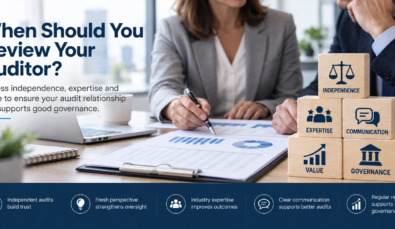
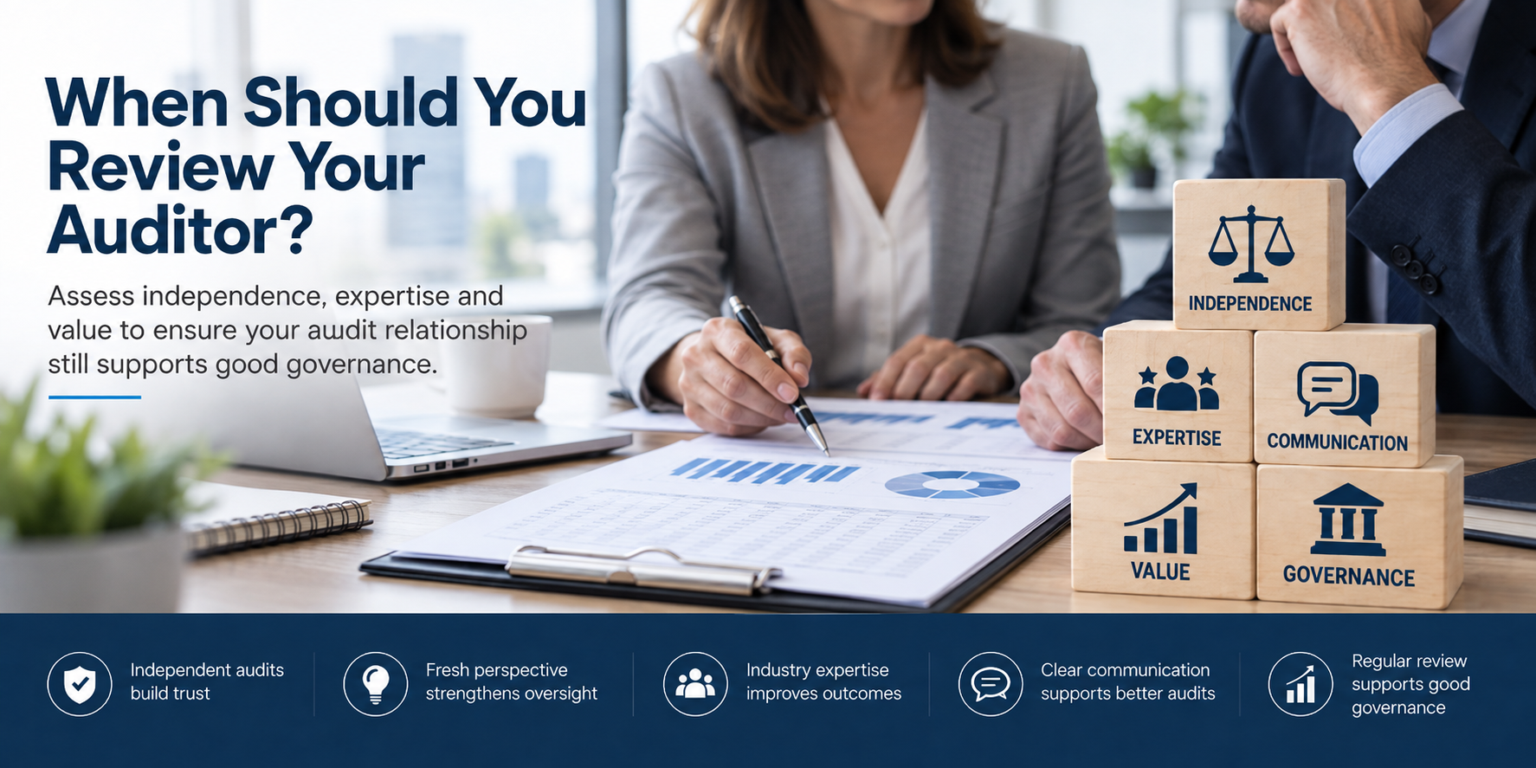
For many organisations, appointing an auditor can become something of a set-and-forget decision. Once an audit firm understands the organisation, its systems and its people, retaining the same auditor year after year can feel like the simplest option.
There are certainly advantages to continuity. But familiarity alone should not be the reason an audit relationship continues indefinitely.
Boards, directors and management teams should periodically consider whether their auditor is still providing the independence, expertise, challenge and quality of service their organisation needs.
Reviewing your auditor does not necessarily mean changing audit firms. Instead, it provides an opportunity to assess whether the current relationship remains appropriate, supports good governance and continues to deliver value to the organisation.
Why Should You Review Your Auditor?
An external audit plays an important role in providing confidence in an organisation’s financial reporting. But a quality audit should offer more than simply meeting a statutory or regulatory requirement.
The audit process can also provide an independent perspective on financial controls, processes, governance and areas of business risk.
As your organisation grows and changes, your requirements may change too. New systems, acquisitions, regulatory obligations, funding arrangements or more complex organisational structures can all affect what you need from your auditor.
Periodically reviewing the relationship can help ensure your auditor continues to be the right fit.
How Often Should You Review Your Auditor?
There is no single review timetable that will be appropriate for every organisation.
Rather than waiting until there is a problem with the audit relationship, boards and management teams should consider the auditor’s performance periodically as part of their wider governance and oversight responsibilities.
An auditor review may be particularly worthwhile when:
- the organisation has grown significantly
- its ownership or corporate structure has changed
- there have been acquisitions or new business activities
- regulatory or reporting requirements have become more complex
- the organisation has entered new industries or markets
- there have been significant changes to senior management or the board
- concerns have arisen around communication, audit quality or service
- audit fees have increased significantly
- the existing audit relationship has been in place for a long period.
Organisations should also consider any applicable independence and audit partner rotation requirements.
The important distinction is that periodically reviewing your auditor does not automatically mean periodically changing audit firms. A review may simply confirm that the current firm continues to provide the right combination of independence, expertise, service and value.
Reviewing Your Auditor Is Also Good Governance
Auditor oversight should form part of an organisation’s broader governance framework.
Boards and directors are responsible for maintaining appropriate oversight of financial reporting, risk and internal controls. The external auditor provides an important independent perspective on many of these areas.
A regular review of the audit relationship can therefore help directors consider questions such as:
- Are we receiving sufficient independent challenge?
- Are significant financial reporting or control issues being brought to our attention?
- Does the auditor communicate effectively with the board or audit committee?
- Are audit findings being followed up appropriately?
- Has the organisation changed in ways that create new financial, compliance or governance risks?
- Does our assurance framework still reflect the risks facing the organisation today?
The audit itself should not be viewed in isolation from the organisation’s wider governance, risk and compliance framework.
Strong governance requires organisations to understand their risks, establish appropriate internal controls, maintain clear accountability and regularly assess whether those systems are operating effectively.
For organisations experiencing growth, regulatory change or increasing complexity, a broader Governance Risk and Compliance review can complement the external audit process by identifying gaps in governance structures, risk management processes, policies, internal controls and compliance arrangements.
What Should You Consider When Reviewing Your Auditor?
A useful auditor review should look beyond whether the audit was completed on time or within budget.
The aim is to assess whether the relationship continues to provide the independence, capability, communication and quality your organisation requires. That means considering both the technical quality of the audit and the wider value the audit relationship provides to your board, management team and organisation.
The following seven areas provide a useful framework for reviewing whether your current auditor remains the right fit.
1. Maintain Auditor Independence and Objectivity
Independence is fundamental to a credible external audit.
An auditor needs to be able to assess financial information objectively and challenge management where necessary. A long-standing relationship can provide valuable institutional knowledge, but organisations should also remain conscious of the potential risks associated with excessive familiarity.
Reviewing the audit relationship gives your board or management team an opportunity to consider whether the auditor continues to demonstrate appropriate independence, professional scepticism and willingness to ask difficult questions.
This does not automatically require changing audit firms. Depending on the organisation and applicable requirements, measures such as audit partner rotation may also help protect independence.
What matters is ensuring that familiarity has not replaced appropriate professional challenge.
2. Bring a Fresh Perspective to Your Business
One of the potential benefits of reviewing your auditor is the opportunity to consider whether your organisation is still receiving a sufficiently fresh and questioning perspective.
An effective auditor should be prepared to question established processes or assumptions that have become accepted simply because “that’s how we’ve always done it”.
The audit process may identify:
- weaknesses in internal financial controls
- inefficient or duplicated processes
- emerging areas of financial or operational risk
- inconsistencies in policies or procedures
- opportunities to strengthen reporting and governance.
Even when you decide to retain your existing auditor, conducting a formal review can encourage a more constructive discussion about what could be improved in future audits.
3. Make Sure Your Auditor Still Understands Your Industry
Audit requirements are rarely identical from one organisation to another.
Different industries face different accounting issues, regulatory obligations and business risks. An auditor who understands your sector can therefore bring significantly more context to the engagement.
When reviewing your auditor, consider whether the audit team has sufficient experience with organisations of your type, size and complexity.
For businesses operating in highly regulated or specialist industries, relevant sector knowledge can be particularly valuable.
An auditor who understands your operating environment is better positioned to recognise unusual transactions, identify emerging risks and focus attention on the areas that matter most.
4. Assess Whether Your Organisation Has Outgrown Its Auditor
The audit firm that suited your organisation five or ten years ago may not necessarily be the best fit today.
Perhaps your business has expanded interstate, introduced new entities, completed acquisitions, adopted more sophisticated technology or significantly increased its turnover.
Growth often creates additional complexity.
Your auditor should have access to the technical knowledge, resources and specialist expertise needed to support that complexity.
Consider whether your existing audit team has kept pace with your organisation and whether it has the capacity to meet your likely future requirements, not simply your needs today.
5. Review the Quality of Communication
A successful audit relationship relies heavily on communication.
Your auditor should clearly explain what information they require, identify issues promptly and discuss findings in language that management and board members can understand.
Ask yourself:
- Are audit requirements communicated early enough?
- Does the audit process run efficiently?
- Are queries handled promptly?
- Are potential issues raised before they become last-minute problems?
- Are audit findings explained clearly?
- Does the auditor engage effectively with your board, audit committee or management team?
An audit may be technically sound while still creating unnecessary frustration because of poor planning or communication.
Reviewing the relationship allows these issues to be identified and addressed.
6. Consider Whether You’re Receiving Value Beyond Compliance
An external auditor must remain independent, so there are limits to the additional services and advice an auditor can provide to an audit client.
That does not mean your audit and assurance services should provide no broader value.
A thorough audit can highlight matters such as weaknesses in internal controls, inconsistencies in processes, financial reporting risks and opportunities to improve governance.
If the only interaction you receive from your auditor each year is a request for documents followed by an audit report, it may be worth asking whether you could be getting more from the engagement.
The strongest audit relationships combine independence with constructive communication and meaningful observations about the organisation’s systems and controls.
7. Check Whether Audit Fees Still Represent Value
Price should not be the only factor used to assess an auditor.
Choosing an auditor purely on the basis of the lowest quote may result in an audit team with insufficient resources, experience or time to properly understand your organisation.
However, audit fees should still be reviewed periodically.
Consider the fee alongside:
- the experience and seniority of the audit team
- time spent understanding your organisation
- industry expertise
- responsiveness and accessibility
- quality of reporting
- continuity of the audit team
- efficiency of the audit process
- insights provided following the audit.
The objective should be to assess value, rather than simply cost.
What Questions Should You Ask When Reviewing Your Auditor?
A structured auditor review does not need to be complicated.
Boards and management teams could consider questions such as:
- Does our auditor remain appropriately independent?
- Does the audit team challenge management when appropriate?
- Does the auditor understand our organisation and industry?
- Has the audit team kept pace with changes in our organisation?
- Is the audit process well organised and efficient?
- Are findings communicated clearly and promptly?
- Are significant control or governance issues being identified?
- Are we receiving useful insights from the audit?
- Do we have access to the right level of senior audit personnel?
- Are the audit fees reasonable for the scope and complexity of the engagement?
- Would another audit firm bring capabilities or perspectives that we currently lack?
Documenting the answers can make it easier to determine whether improvements can be made within the existing relationship or whether it is appropriate to test the market.
Does Reviewing Your Auditor Mean You Should Change Audit Firms?
Not necessarily.
There can be considerable value in retaining an audit firm that understands your organisation and continues to provide a high-quality, independent service.
Changing auditors also involves an initial learning curve as a new audit team develops its understanding of your organisation, systems and risk profile.
The purpose of a review is therefore not to change auditors simply for the sake of change.
Instead, it is good governance to periodically ask whether the existing relationship continues to serve the organisation well.
If your auditor remains independent, appropriately challenges management, understands your industry, communicates effectively and provides a high-quality audit, a review may simply confirm that the relationship remains the right one.
If significant gaps emerge, however, it may be time to explore your options.
Considering a Change of Auditor?
An audit should provide confidence in your organisation’s financial reporting while also helping your board and management better understand financial controls, governance and areas of potential risk.
At MGI South Queensland, our Audit and Assurance team works with organisations across a range of industries to deliver independent, practical and commercially focused audit services.
We aim to make the audit process as straightforward as possible while looking beyond basic compliance to identify issues and opportunities that can strengthen your organisation.
If you are reviewing your existing audit arrangements or considering appointing a new auditor, contact our team to discuss your audit and assurance requirements.
FAQs About Governance, Risk Management & Compliance
Governance risk management and compliance refers to the combined framework used to manage decision-making, risk oversight and compliance obligations. It helps organisations operate responsibly, reduce risk and improve accountability.
GRC compliance refers to the processes an organisation uses to ensure governance, risk management and compliance obligations are properly managed. It helps organisations identify obligations, assign responsibilities, monitor risks and maintain evidence that requirements are being met.
A business may need a GRC review when it is growing, preparing for audit, facing increased compliance obligations, concerned about internal controls, changing structure or seeking greater confidence in governance and reporting.
Internal audit supports governance, risk and compliance by independently reviewing whether controls, policies and processes are operating effectively. It helps management and boards identify risks, weaknesses and improvement opportunities.
Yes. Governance, risk and compliance services can be valuable for small and medium businesses, especially when they are growing, preparing for audit, managing new compliance obligations or improving internal controls.