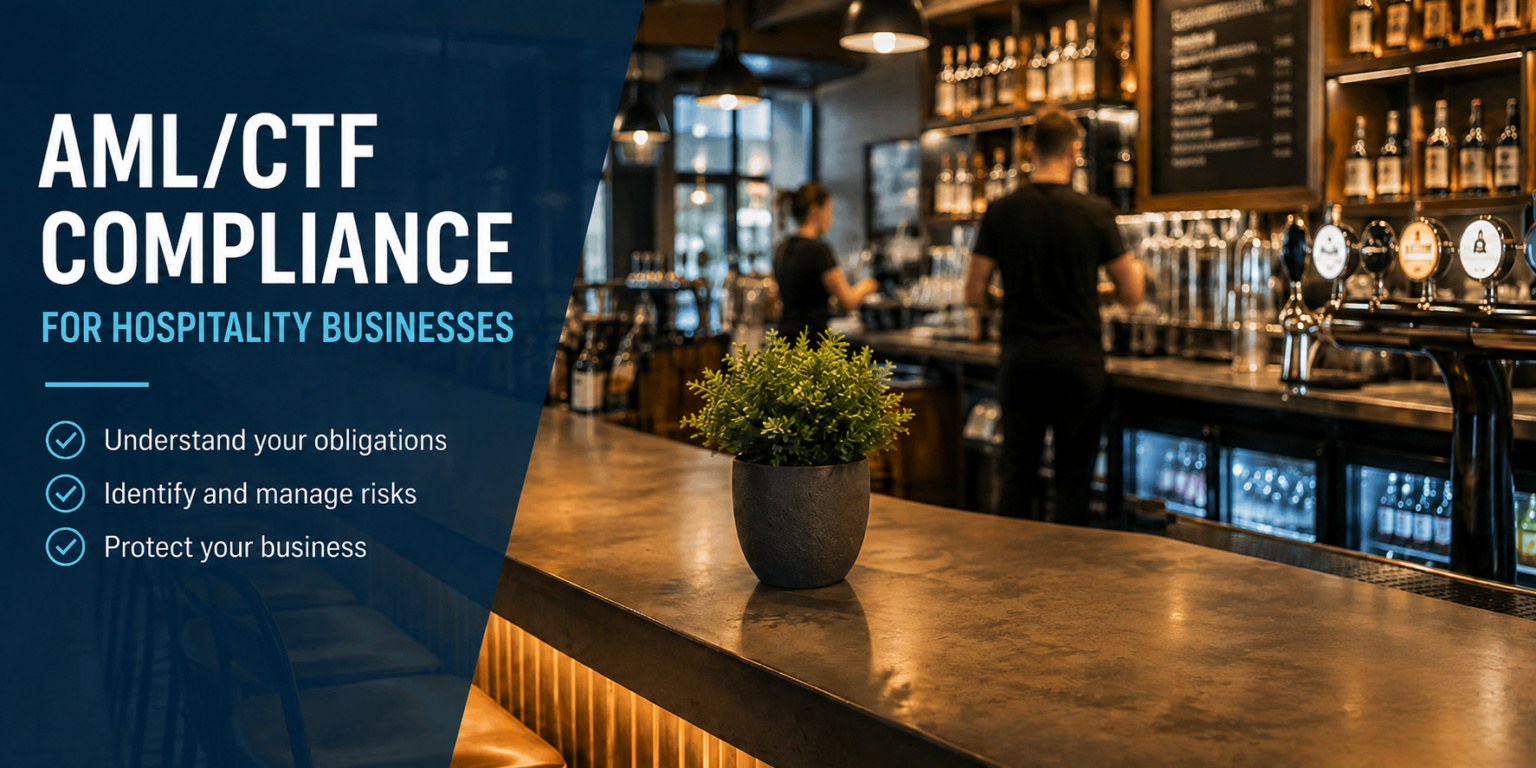
For many hospitality businesses, anti-money laundering and counter-terrorism financing compliance (AML/CTF) has not traditionally been front of mind. Daily priorities are usually staff, rosters, suppliers, bookings, venue costs, cash flow and customer experience.
However, Australia’s AML/CTF regime is changing and some hospitality businesses already have obligations or may be more exposed to money laundering risks than they realise.
This is particularly relevant for hospitality groups, pubs, clubs and hotels that operate gaming machines, manage high volumes of cash, deal with complex ownership structures or are buying, selling or restructuring venues.
AML/CTF compliance does not need to become an oversized administrative burden. However, hospitality businesses do need to understand where the rules may apply, what risks exist and what practical steps should be taken to strengthen compliance.
What is AML/CTF?
AML/CTF stands for anti-money laundering and counter-terrorism financing.
In simple terms, the AML/CTF regime is designed to prevent criminals from using legitimate businesses to move, hide or disguise the proceeds of crime.
Money laundering can happen when funds from illegal activity are introduced into the financial system and made to appear legitimate. In hospitality, this may be a concern where venues handle large volumes of cash, operate gaming facilities or are involved in high-value business transactions.
AML/CTF compliance is about understanding these risks, putting appropriate controls in place, keeping records, training staff and reporting suspicious activity where required.
Why hospitality businesses should pay attention
Not every cafe, restaurant, bar or accommodation business will automatically be regulated under Australia’s AML/CTF laws.
However, some hospitality businesses are more likely to have AML/CTF obligations or exposure, particularly where they provide designated services. For example, pubs, clubs and hotels that operate electronic gaming machines can be captured because gambling services are regulated under the AML/CTF regime.
Even where a venue is not directly regulated, AML risk can still arise through:
- large cash transactions
- unusual customer behaviour
- gaming activity
- complex ownership structures
- venue acquisitions or disposals
- property transactions
- investor arrangements
- loans or private funding
- related entities and trusts
- rapid business growth or restructuring
For hospitality operators, the key issue is not to panic. It is to understand whether the business provides regulated services, identify where risk may exist and make sure compliance processes are proportionate to the size and nature of the venue.
Hospitality venues with gaming machines
Pubs, clubs and hotels with electronic gaming machines are a particularly important part of the hospitality sector from an AML/CTF perspective.
Gaming activity can present money laundering risks because customers may be able to place, move or disguise funds through gambling transactions. As a result, venues with gaming operations may need to have appropriate AML/CTF systems, processes and staff awareness in place.
This may include:
- having an AML/CTF program
- identifying and verifying customers where required
- monitoring for unusual activity
- keeping appropriate records
- training staff to recognise red flags
- reporting suspicious matters where required
- reviewing the effectiveness of controls
For many hospitality businesses, the challenge is making these obligations practical. A venue does not need theoretical compliance documents that sit in a drawer. It needs processes that work in the context of busy shifts, casual staff, managers under pressure and real customer interactions.
What changed under Australia’s AML/CTF reforms?
Australia’s AML/CTF laws have expanded to cover more professions and business activities.
From 1 July 2026, additional sectors are captured under the AML/CTF regime, including accountants, lawyers, conveyancers, real estate professionals, trust and company service providers and dealers in precious metals and stones.
For hospitality businesses, this matters for two reasons.
First, hospitality operators may deal with these newly regulated professionals when buying, selling, restructuring or financing a venue. For example, accountants, lawyers, conveyancers and real estate professionals may now need to undertake additional checks when providing certain services.
Second, the reforms reflect a broader compliance environment where businesses are expected to take financial crime risk more seriously. Hospitality operators with higher-risk features such as gaming, cash handling, complex ownership structures or venue acquisitions, should be especially aware of their AML/CTF exposure.
What AML compliance may involve for hospitality businesses
The exact requirements will depend on whether the business is a reporting entity and what designated services it provides.
However, AML/CTF compliance may involve:
Understanding whether the rules apply
The first step is to determine whether the business provides designated services under the AML/CTF regime.
For hospitality businesses, this may include reviewing whether the venue operates gaming machines, provides gambling services, deals with certain financial services or is involved in other regulated activities.
Assessing money laundering and terrorism financing risks
An AML/CTF risk assessment helps identify where risk may arise in the business.
For a hospitality business, this may include considering:
- cash handling
- gaming machine activity
- customer behaviour
- transaction patterns
- venue location
- customer demographics
- ownership structure
- related entities
- third-party funding
- acquisition or sale activity
The aim is to understand the real-world risks in the business, not to create unnecessary paperwork.
Developing an AML/CTF program
Where required, an AML/CTF program sets out how the business identifies, manages and reduces money laundering and terrorism financing risks.
For hospitality operators, this should be clear, practical and usable by management and staff.
Training staff
Staff are often the first people to notice unusual behaviour.
Training should help team members understand what to look for, how to record concerns and when to escalate issues internally.
In a hospitality environment, training needs to be practical, simple and relevant to the roles people actually perform.
Keeping appropriate records
AML/CTF compliance relies on accurate records.
This may include records relating to customer due diligence, risk assessments, internal reviews, staff training, suspicious activity escalation and compliance decisions.
Reviewing and improving controls
AML compliance is not a one-off task. Businesses should regularly review whether their controls remain appropriate, especially when operations change, a new venue is acquired, gaming activity increases, staff turnover is high or the business structure changes.
Common AML red flags in hospitality
Hospitality venues, especially those with gaming facilities, should be alert to behaviour that may indicate money laundering risk.
Examples may include:
- customers using large amounts of cash with little interest in the actual gaming activity
- frequent transactions just below reporting or internal review thresholds
- customers asking unusual questions about payouts or records
- third parties appearing to control or direct customer activity
- reluctance to provide identification when required
- inconsistent or unusual explanations about source of funds
- repeated activity that does not appear commercially or behaviourally normal
- attempts to avoid staff attention or internal processes
A red flag does not automatically mean wrongdoing has occurred. However, it should prompt staff to follow the venue’s internal procedures.
Why AML/CTF compliance should not be left until there is a problem
AML/CTF compliance is much easier to manage before there is a regulatory issue, suspicious incident or transaction that raises concern.
A proactive approach can help hospitality businesses:
- understand whether AML/CTF obligations apply
- reduce compliance gaps
- improve staff confidence
- strengthen internal controls
- support better governance
- prepare for audits or independent reviews
- reduce reputational risk
- demonstrate that risks are being actively managed
For venue owners and hospitality groups, this can also support broader business resilience. A venue with clear systems, records and controls is often easier to manage, finance, acquire, sell or scale.
AML/CTF considerations when buying or selling a hospitality business
AML/CTF risk is not limited to day-to-day operations.
Hospitality businesses should also consider AML/CTF issues during major commercial events, such as:
- buying a pub, club, hotel, restaurant or accommodation business
- selling a venue
- restructuring ownership
- bringing in investors
- changing directors or shareholders
- establishing trusts or related entities
- refinancing or raising capital
- expanding into new venues
These transactions often involve lawyers, accountants, financiers, real estate professionals and other advisors. With the expanded AML/CTF regime now covering more professional services, hospitality operators may encounter more customer due diligence and documentation requirements during major transactions.
Preparing early can help avoid delays and make the process smoother.
How MGI South Qld can help hospitality businesses
We work with hospitality businesses to provide practical financial, tax, audit and advisory support.
For AML/CTF compliance, we can help hospitality operators understand their obligations, assess their current position and take practical steps to improve their compliance framework.
Our support may include:
- AML/CTF compliance reviews
- AML audit and independent evaluation support
- AML/CTF risk assessment support
- policy and procedure reviews
- customer due diligence
- process reviews
- staff training and responsibility mapping
- record-keeping reviews
- practical action plans to address gaps
We understand that hospitality businesses need compliance processes that work in a fast-moving environment. Our approach is practical, proportionate and designed to support the way your business actually operates.
AML/CTF compliance is becoming more important across the Australian business landscape and hospitality operators should not assume the issue only applies to banks or large financial institutions.
For pubs, clubs and hotels with gaming machines, AML/CTF obligations may already be a key compliance area. For other hospitality businesses, the risk may arise through cash handling, ownership structures, transactions, finance arrangements or major business changes.
The best starting point is to understand your exposure and take practical steps from there.
If your venue or hospitality group needs practical support, MGI South Qld provides AML audit and anti money laundering consulting services to help assess your current position and identify next steps.
FAQs About AML/CTF Compliance For Hospitality Businesses
No. Not every hospitality business is automatically captured by AML/CTF obligations. However, businesses that provide designated services such as certain gambling services, may have obligations. Hospitality businesses should assess whether the rules apply to their specific activities.
Pubs, clubs and hotels that operate electronic gaming machines may be captured by AML/CTF obligations because gambling services are regulated under the AML/CTF regime. These venues may need appropriate systems, controls, staff training and reporting processes.
An AML audit is a review of how a hospitality business manages money laundering and terrorism financing risks. It may examine policies, customer checks, staff training, risk assessments, reporting processes, records and the effectiveness of internal controls.
AML/CTF red flags may include unusual cash activity, repeated transactions just below thresholds, customers reluctant to provide identification, suspicious gaming behaviour, unclear source of funds or third parties appearing to control customer activity.
Yes. Buying, selling or restructuring a hospitality business may involve additional checks by accountants, lawyers, conveyancers, real estate professionals or financiers. Having clear records and well-managed compliance processes can help reduce delays and improve transaction readiness.
MGI South Qld can help hospitality businesses understand whether AML/CTF obligations may apply, review existing processes, identify gaps, prepare practical action plans and support AML audit or independent evaluation requirements.