When a business collapses only to reappear under a new name, it can raise serious red flags – especially if debts, taxes and employee entitlements have been left behind. This practice is known as phoenixing. While there are legitimate reasons for winding up and restructuring a business, illegal phoenix activity is a different story. It involves directors deliberately shutting down one company to avoid paying debts then starting a new entity to continue trading. The Australian Taxation Office (ATO) and regulators have a close focus on this practice, as it undermines fair competition and leaves creditors, staff and the community out of pocket. But what is phoenix activity and how can business owners identify and protect themselves from illegal operators?

The ATO and Australian Securities and Investments Commission (ASIC) are actively pursuing this issue. They are increasing scrutiny and enforcement actions against phoenix companies. As a business owner, knowing the signs of illegal phoenix activity can help you avoid potential issues that may leave you financially exposed.

What Is Phoenixing?

The term phoenixing comes from the mythical bird, known for rising from its ashes but what is a phoenix business?

Phoenixing a company means resurrecting, restructuring or renewing it and describes companies that are liquidated only to be reborn as new entities. It refers to a company that is deliberately shut down and replaced by a new one, often with the same directors, to continue operating without the burden of previous debts.

Not all phoenix activity is unlawful. In some cases, directors may legitimately close a failing business and start again, provided they meet their obligations to employees, creditors and the ATO. The problem arises when this process is used to deliberately avoid paying debts. Illegally phoenixing a business typically leaves creditors, suppliers, staff and the community at a loss, while the directors continue trading through a fresh company.

How Illegal Phoenix Activity Works in Practice

Illegal phoenixing usually follows a clear pattern. A company is deliberately wound up with outstanding debts to the ATO, suppliers or employees. Its assets may be transferred to a related entity at little or no cost, while the directors quickly establish a new business that looks much the same as the old one. From the outside, it can appear as though nothing has changed – same staff, same premises, sometimes even the same trading name – yet the original debts are left behind.

This practice is most often seen in industries where cash flow is tight and competition is fierce, such as construction, labour hire, transport and hospitality. It allows unscrupulous directors to gain an unfair advantage by cutting costs they legally owe, while their competitors are left carrying the full burden of tax, wages and supplier payments.

The fallout extends far beyond the immediate business relationships. Employees can lose unpaid wages and superannuation, creditors are left chasing debts that will never be recovered, and the broader economy suffers when millions in tax revenue is lost.

How Can You Spot Illegal Phoenixing?

There are some common tactics employed in a phoenix company that can be red flags to be aware of and help protect your business both financially and reputationally.

Red Flags to Watch For:

  • Regular creation of new companies for specific projects
  • Minor variations to a company name but with the same address and owners
  • Recurrent insolvency without genuine reasons
  • Appointing ‘dummy’ directors to protect actual players from legal consequences
  • Unexplained transfer of assets at undervalue
  • Patterns of director resignations before liquidation
  • Recent changes in management or legal structure
  • Business owners offering unusually low prices to win contracts

Records might be obscured or destroyed, making it difficult to trace financial histories. This deliberate concealment complicates investigations and recovery efforts. Affected parties, including the ATO, struggle to reclaim outstanding debts. This results in significant economic losses and undermines the integrity of honest businesses.

How Can Businesses Protect Themselves From Illegal Phoenix Activity?

Illegal phoenixing often leaves others to pick up the pieces, but there are steps that businesses can take to reduce their risk.

  • Do your due diligence – before entering into contracts, check the background of the company and its directors. ASIC registers and ABNs can provide useful insights as well as Directors Identification Numbers (DINs).
  • Look out for warning signs – frequent changes of company name, directors or ABN, unexplained asset transfers or a history of unpaid debts may indicate phoenix behaviour.
  • Get agreements in writing – Clear contracts that outline payment terms and responsibilities can help if disputes arise.
  • Monitor payments closely – Be cautious of customers who consistently delay or avoid paying invoices.
  • Amend credit terms – pursue outstanding debts and amend credit terms for any supplier you hold concerns about.
  • Implement strong internal controls – regular audits can help identify irregular or fraudulent activity among suppliers.
  • Seek advice early – If you suspect a business relationship could be at risk, professional advice can help you take protective measures.

For directors themselves, the best protection is to stay compliant. This means maintaining accurate records, lodging tax returns on time, paying employee entitlements and seeking professional help if financial difficulties emerge. Acting early often opens up more legitimate restructuring options and reduces the risk of breaching the law.

Engaging professional advisers can also help. They offer insights into potential risks and ensure you aren’t unwittingly involved with a phoenix company. Taking proactive measures can help avoid financial harm for your own business.

Professional Support Benefits:

  • Identify potential risks early
  • Ensure compliance with regulations
  • Receive up-to-date advice on best practices
graphic showing how illegal phoenix activity works

The Impact of Illegal Phoenix Activity on Small Businesses and the Economy

Illegal phoenixing is a significant issue in Australia, costing the economy billions each year. It affects small business owners who may unknowingly engage with phoenix companies. In fact, according to the ATO illegal phoenix activity costs the economy in the region of $4.89 billion annually.

Because of the damage it causes, illegal phoenix activity is a top priority for regulators. The Australian Taxation Office (ATO), ASIC and other government agencies work together to detect and prosecute directors who attempt to walk away from their obligations.

Illegal phoenix activity distorts fair competition, allowing dishonest companies to undercut rivals who fulfil their obligations. For small businesses, the ripple effects can be devastating. Suppliers and contractors might face unpaid invoices, affecting their cash flow and sustainability. This financial strain can lead to broader economic issues, including job losses.

Key Differences Between Legal Restructuring and Illegal Phoenixing

It is important to understand that not every business that closes and starts again is acting illegally. Sometimes companies genuinely face financial difficulty and need to restructure to survive. If handled correctly, this process can be completely lawful and even in the best interests of creditors and employees.

The distinction lies in intent and compliance. Legal restructuring follows proper processes, such as voluntary administration or liquidation, with assets sold at fair value and proceeds distributed to creditors in line with the law. Employees are paid their entitlements and directors meet their reporting and tax obligations.

Illegal phoenixing, on the other hand, occurs when directors deliberately avoid these responsibilities. Assets may be transferred for less than market value or not recorded at all, creditors and staff are left unpaid, and the directors attempt to carry on trading as if nothing has happened.

By recognising the difference, business owners can ensure they restructure in a way that is both compliant and transparent, avoiding the serious penalties linked to illegal phoenix activity.

How MGI South Qld Can Help

Having a business partner you can trust in your corner can reduce stress and anxiety if you suspect you’re in business with phoenix operators. Our team can:

  • Help you with due diligence to minimise risks to your business
  • Provide timely advice on dealing with the situation if you suspect you’re dealing with illegal operators
  • Support directors in meeting their governance responsibilities
  • Provide advice on restructuring options that protect your business and meet your obligations
  • Assist with cash flow and tax planning to avoid financial stress

By working with us, you can get timely advice on the correct steps to take should you fall victim to scam operations. If you are concerned about potential exposure to phoenix activity – whether within your own company or through dealings with others – our advisors are here to help you take the right steps.

Key Takeaways for Small Business Owners

Understanding phoenix activity is crucial for protecting your business. Staying aware enables you to minimise the risks of doing business with illegal operators.

Here are important points to keep in mind:

  • Conduct thorough due diligence on potential business partners.
  • Maintain clear and precise financial records.
  • Seek professional advice from tax advisers to stay compliant.

These practices help avoid unintentional involvement in illegal phoenix activities. They also safeguard your business interests and reputation.

Performance Based Rewards: The Way To Win The Salary War!

Are you losing staff due to higher alternative salary rates on offer in the market? Then offering performance based rewards will assist you to retain staff and improve your bottom line!

Research indicates Generation Y has high earnings expectations and wants rewards based on performance. To implement an effective performance based rewards program, your staff needs to have input and agree to what is expected of them (“deliverables”).

Establish the deliverables for both individuals and team positions. These can include a range of quantitative (objective) and qualitative (subjective) assessment criteria. Once the deliverables are agreed, you will apply a weighting to each criteria. This will depend on the strategic and operational objectives of your business (grow sales, new customers, better productivity etc). A staff member’s result determines the amount of their performance bonus. The more they deliver the higher their rewards. It’s a win for both owners and their staff.

Case Study

David needs to grow sales and improve profitability. David’s concern is his staff costs are increasing and profits are declining. He has now implemented the Staff Value Program and agreed to pay Tom, a key staff member, a maximum bonus of $20,000. The payment of the bonus is conditional upon Tom meeting specific performance targets. Below is his bonus score card.

The qualitative assessment process allows business owners to assess the achievements of their staff and the criteria are measurable by observation. It provides a proactive approach for addressing subjective performance matters that are otherwise usually left unresolved.

Once the Staff Value Program is implemented by your business, you then need to ensure you have the systems and procedures in place to measure your staff’s performance on a timely basis. As performance bonuses are paid as a result of exceeding budgeted profits, business owners are beginning to realise they can compete with apparently higher alternative salary rates on offer in the market and retain their staff by paying a sufficient bonus based on performance.

examples of performance based rewards shown in a table | MGI

The business advisory team at MGI have specialists who have helped businesses like yours develop a performance based reward program. A business coach from MGI can help you to implement a similar scheme and help improve your staff retention. We always have a clear focus on managing costs and improving profitability. We offer expert business growth support and can also assist with business benchmarking and analysis to ensure your business remains competitive.

You’ve grown your business gradually and now your minds turn to collecting your reward from your investment capital, know-how, and years of effort. Achieving the most for your business requires the same diligence it took grow it. This is where having a business succession plan becomes vital.

So how can you ensure you receive a return for your efforts?

Developing a effective plan for business succession is the key protecting, growing and realising the maximum value for your business. It is a strategic process that allows you to smoothly transition the ownership and/or management for your business.

Research shows that business value can be impacted by a  number of issues including:

Why is business succession a key issue now?

Times change, markets change, and so does the business environment. Not long ago, business entry costs and competitive forces were lower and business growth could be funded by borrowing against increasing house prices.

Business success demands focus by you on the operation, but ultimately, issues of success and retirement will creep up. By then, getting the price you need could be elusive.

The next generation of business owners, Generation Y, face a completely different business environment. Start-up and acquisition costs are higher, regulatory barriers are higher, and competition has increased. Business funding opportunities are also more limited in comparison.

You’re a business owner and you understand the driving forces behind competition, supply and demand.

So when do you need to start developing a plan for business succession?

Thus, it is important for you to start planning your succession now. Talk to the business advisory team at MGI about our succession planning services and let us help you start the process.  We can help you benchmark your business against others in the market, strategic planning planning, wealth management and business valuations.

You might also be interested in our previous blog about business exit strategy.
What are the key factors to optimise business value?

Value optimisation is all about growing business value. Value optimisation factors are issues within the business that can be planned for and addressed prior to selling that will assist in a smooth sale transaction at the optimum price. The key value areas for your business are growth, performance and succession. By focusing on optimising these areas, your business value will improve.

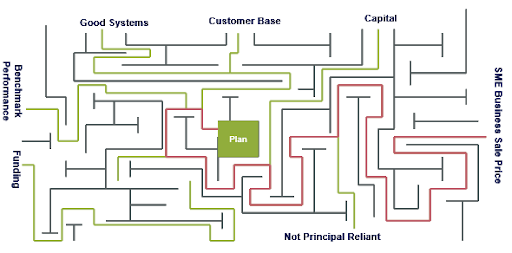
The path to value optimisation

The following illustration demonstrates the path you can take to optimise the value of your business.

Small Business Planning Image #1

Confused? How do I address these factors in my business?
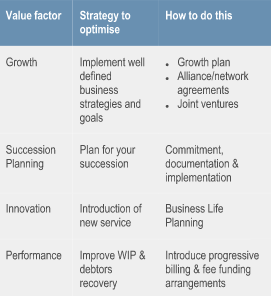
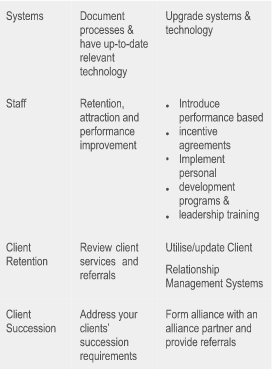
Take a look at the following table that provides an indication of some of the industry best practice strategies that can be implemented to address these key value factors.

Screen Shot 2021 07 26 At 12.09.23 Pm
Screen Shot 2021 07 26 At 12.09.39 Pm

By addressing all of the above value factors, you will improve profit, improve the value of your business, and maximise your position when it is time to sell.

Some of the barriers to improving the value of your business and achieving your desired sale price could include:

  • Business being too principal reliant
  • Not spending enough time working on your business
  • Expenses out of control
  • Lack of client segmentation
  • Poor systems and processes
  • Unrealistic expectations about the value of your business

If any of these barriers are relevant to your business, these should be addressed. Contact your MGI advisor should you require any business coaching or help with business planning.

Disclaimer: this information is of a general nature and should not be viewed as representing financial advice. Users of this information are encouraged to seek further advice if they are unclear as to the meaning of anything contained in this article. Bstar accepts no responsibility for any loss suffered as a result of any party using or relying on this article.

Pppm Mgi Blog

PPPM spells happiness.  According to a recent course (University of Texas) ROI and Happiness:

Pleasure
Positivity
Purpose
Meaning

This all leads to happiness in the workplace.

An esoteric concept, no not at all, but one to easily diminish if you don’t care about your people.  Remember how you treat your people tells everything about you. We are not talking about avoiding negativity at all costs and pretending to be happy (note: high performing teams cannot carry passengers). Happiness leads to success not the other way around. It’s about being optimistic and resilient, employees are as responsible as employers to achieve workplace happiness.  Attitude becomes a more important attribute than skill.

So, what does the science say:

  • Happier people are physically healthier so take less sick leave (16 days less).
  • Retention improves dramatically.
  • Happier people are also more collegial, so they are better team players.
  • Happier people are more creative and make better or more objective decisions.
  • Organizations with happier employees are more productive and profitable. (outperformed S&P top 500 14 times)

This is why investing in employee happiness is a very smart thing to do.

To start with it would be useful for organizations to gain an understanding of the five main determinants of employee happiness: basic needs, autonomy, mastery, belonging and abundance culture.  The issue is having balance, all are important and people perform best when they are in the ‘flow’, their competence is matched to their challenges.

Pppm 2

Employees can do even more for their own happiness. In fact, the employee should be encouraged to take the lead.

The health of our relationships at work is more important than physical health in relation to happiness. The science shows, the more you genuinely care for your co-workers, the happier and more successful you are likely to be. Culture is an important determinant of happiness because culture is a feature of the environment and the environment wields a powerful influence over our behaviors.

Simple things the employer can do:

  • Create equality among employees.
  • Treat external stakeholders, particularly your suppliers well.
  • Hire based on values.
  • Make mastery part of performance review.
  • Give $200 to your employees to personalise their workspace.
  • Make employees take their leave.
  • Reduce face time at work.
  • Reduce too many rules.

Simple things the employee can do:

  • Make the effort to stay well (healthy lifestyle).
  • Express gratitude.
  • Seek happiness outside of work.
  • Don’t do work on leave.
  • Use your most productive time to be creative.
  • Maintain a desire for learning (mastery).

In conclusion, a word of caution, you will be happier at work and hence, more successful. This is good, but if you are not careful, the success can sabotage your happiness.  Wealth seems to be especially potent at relationship spoiling. Studies show that the wealthier we become, the less we prioritize our relationships over things like making money and being even more successful.

Are we paddling in the same direction at the same speed (scope, budget and schedule) and not up S##t Creek? How do you build team engagement and what makes an effective team?

Team 1

Team is a common term that is not practiced well.  Some of us have had the good fortune to have been in high performing teams and the memories and relationships are still important to us. Our memories connect us to doing a good job, exceeding expectations, learning, celebrating and having a sense of meaning and belonging.  Teams just don’t happen, are often less effective than a group of individuals and can be terribly inefficient.


Basics first, what are the attributes of a team:

  • Complimentary skills
  • Common purpose
  • Shared performance goals
  • Mutual accountability

What makes an effective team?

  • Purpose
  • Clear goals
  • Complimentary perspectives and skills
  • Process and timings are clear
  • Reflective learning and celebration
Team 2

Problem solving: trust and communication

Team 3

Tactical: clarity/ directive style

Team 4

Creative: Freedom/ autonomy

Questions to ask your team regularly:

  • How did you feel?
  • What did you learn?
  • How were you affected?
  • What inter-discipline issues should you consider?

A leaders willingness to discuss learnings and openness to constructive criticism will over time, develop team engagement.  This social exchange develops trust and a reciprocation of benefits.  In the eye of the beholder, perception of mutual obligation develops and how an individual interprets cues and signals from their leader.  No cues and signals, no teamwork, failure to deliver on cues and signals is worse than having no cues and signals at all.


In summary, our personal reflections on actions for team-work and what makes an effective team (Bold=Bang for Buck):

  • Equal recognition for contribution
  • Goals should be measurable and defined for those responsible for achieving them
  • Achievement, however big or small, should be recognized and celebrated
  • Deal with issues face to face
  • Commit fully to goals set
  • Act emphatically all the time, but don’t carry passengers
  • Reduce the documentation you need to justify delivery
  • Simplify language
  • Reduce the time it takes to get something approved
  • Set expectations around quality, time and cost, then trust your team to find the best way to do the work.
  • For long-term growth, focus on new ways of behaving, not new ways of working.

These are not new principles.  Check out the biography on Napoleon Bonaparte and one of his quotes was:

‘morale is to physical as three is to one.’

Team engagement and alignment is one of the elements to improve overall performance & offers practical and effective solutions.

You might also be interested in our recent blog on performance based rewards.

One of the reasons businesses run out of cash – and generally go broke – is that they grow too fast. What a paradox – the business is growing too quickly and is therefore too successful for its own good! Not surprisingly, in situations like these you also find that the largest “creditor” of the business has been the Australian Taxation Office, due to either unpaid tax liabilities. In other words, the business has used the ATO as a banker. The obvious question is – why? The broader answer is very simple – lack of access to alternative funders. Debtor financing or debtor funding is one of the options that is generally not explored – but could be a reasonable solution.

What Are The Funding Sources For A Growing Family Business?

A typical family-owned business usually only has two main sources of funding – the owners or the bank – and the latter option is generally only available if the owners have “bricks and mortar” security (i.e. their home).

Where the business owner has little or no equity in their home and/or the funding needs of the business exceeds the amount they can borrow against their home, the options tend to be very limited. Banks may still lend something against the assets of the business (e.g. stock and debtors), but the size of this facility is often a fraction of the assets pledged as security and the facility may not increase as the cash flow needs of the business increase.

Children taking over a business from their parents may also lack the amount of capital (or property security) needed to grow the business.

Family-owned businesses are also reluctant to call in a “white knight” (a friend with cash) or venture capital provider. In any case, the latter are generally not attracted to smaller “mum and dad” family businesses. This therefore only leaves two sources of funding – business creditors and the ATO. Business creditors tend to get looked after as the business owner wants to ensure supply of raw materials to their business, which just leaves the ATO. However, you ought to be aware of recent changes made by the ATO in relation to tax debt interest charges.

One often overlooked source of funding may be to “borrow” against the debtors of the business through a debtor finance arrangement (previously called factoring).

How does debtor financing work?

Traditionally thought of as a lender of last resort, debtor finance companies should not be overlooked as a source of funding for growing businesses, provided the business is profitable. The latter point is crucial, because it is no use accessing cash flow (from anywhere) if the business is not making money. The cash will soon run out and the business will go broke. This was also another reason provided in one of our previous articles about why businesses don’t have cash – they don’t have a cash flow problem, they have a profitability problem. A lack of cash is the symptom, but a lack of profitability is the cause.

Assuming the business is profitable and growing, debtor finance provides an opportunity to borrow against the debtor book, particularly where it is a high quality debtor book. Generally, debtor financing companies will advance a percentage of the debtor book (e.g. 75% or 80%) for those debtors who have been outstanding for less than 90 days.

Benefits of Debtor Financing

Debtor financing offers a wealth of advantages for growing businesses:

1. Improved Cash Flow

Free up cash tied up in outstanding invoices—typically between 70–90% of the invoice value is released upon submission—enabling you to cover wages, supplier costs, or invest in opportunities without waiting for payment terms to end.

2. Growth on Your Terms

As your sales increase, so does your finance limit – making debtor funding more flexible than traditional loans constrained by physical collateral.

3. No Real Estate Security

You’re not required to pledge property. Instead, lenders use your invoices as security, making debtor finance ideal for entrepreneurs without bricks-and-mortar assets.

4. Efficient Credit Control

With invoice factoring, your finance partner often handles debtor collections—leaving you to focus on core business activities.

5. Predictable Funding

Access to funds aligns with invoice generation, and repayments occur only when customers pay. It’s a financing model that adapts seamlessly to your business’s rhythm.

6. Accessible for SMEs

Often quicker to arrange than traditional bank loans, debtor finance is well-suited to companies without extensive asset backing or high turnover.

Different Types of Debtor Finance

Understanding the main forms of debtor funding helps you choose what best fits your operation:

1. Invoice Factoring (Disclosed)

2. Invoice Discounting (Confidential)

3. Full‑Ledger vs Partial‑Ledger Facilities

So, why don’t more family-owned businesses take up debtor financing?

There are a probably number of reasons for this. One reason might be the perceived stigma. Often, debtor financing companies will require that the arrangement be disclosed to the customers of the business and collection of the outstanding debts is handled by the debtor finance company. Whilst this needs to be carefully managed, there could be a “good news story” in here for the business and that story should be “sold”. The business is growing! Every business owner understands that a growing business needs to fund cash. So should your customers.

Secondly, the business is “outsourcing” its debtor management, thereby enabling the owners to focus on doing what they do best – build the business. You may also find that your debtors are better managed (and more likely to pay on time) when there is greater focus applied.

Another reason may be because debtor finance is generally a more expensive form of funding than traditional bank finance secured by a property. This is not surprising – it’s more risky. If the business owner had property to put up as security then they wouldn’t need debtor finance. So it is important to understand what the cost of funds will be. Even if the effective cost of funds is (say) 15%, provided the business is making a return on capital employed (ROCE) of greater than this then they are in front. In other words, if the ROCE for the business is, say, 25% then the business owner is still in front by 10% once the financing cost has been paid. Would you rather make 10% of something or 100% of nothing?

Clearly, in a perfect world having access to an unlimited supply of cash is utopia. However, we don’t live in a perfect world and business owners frequently have to deal with imperfection. The challenge for business owners using any sort of funding, but particularly debtor funding is to know the key financial parameters of their business.

The big three financial ratios every business needs to know

  1. Know your ROCE. If you don’t know this and the areas of your business that drive it, you’re driving blind.
  2. Know your free cash flow (FCF). Work out your after-tax profit. Subtract from this the amount by which the capital employed in the business has grown during the year (or last year). If the answer is negative, you have negative FCF and this can’t be sustained forever.
  3. Know your Working Capital Absorption Ratio. This is simply the amount of additional working capital your business will need to fund a given increase in sales. This can vary significantly from business to business. If you don’t know this and you have a growing business, you’re in risky territory, unless of course you have an endless supply of cash.

At MGI South Queensland our specialist business growth advisors in Brisbane and on the Gold Coast can help you avoid many of the pitfalls of growing your business and ensure you maintain a healthy business cash flow.

We’re also able to offer outsourced CFO services which can be completely tailored to the needs of your organisation. From cash flow planning and management to helping you reduce the risks your business is exposed to, talk to one of our CFO consulting partners today.

This blog was first published in October 2016 and updated in April 2025.

Disclaimer: This information is general in nature and does not take into account your individual objectives, financial situation, or needs. You should consider seeking professional advice before making any financial decisions.

It’s usually easier to look back after a business has failed and identify why, than it is to save a struggling business from failing in the first place. In my view there are a number of reasons for this, not the least of which is the fact that everyone is always wiser with the benefit of hindsight.

However, it begs the question of what a business owner can do if their business is struggling? After all, they have a lot of their heart and soul invested into the business (as well as their capital). It’s their “baby” and they are convinced they’re onto a winner, even if it isn’t working out.

The answer is – it depends.  It depends on many variables including what type of business they’re in, what industry it’s in, where it’s located and what size the business is and what stage it is at in its lifecycle. In my experience, scale can often play a huge part. There are many struggling business owners out there – some might call them micro businesses.

But there is hope. Here are my top four tips to get your business back on track.

Do you know your breakeven point?

When I walk past retail outlets (clothing shops for example), I often wonder if the owner knows how many (or what dollar value) of clothes they must sell each and every day in order to simply breakeven.

One thing many businesses fail to do before even setting up business is a simple breakeven analysis. A business broadly has two types of costs – fixed and variable. As the name suggests, fixed costs are largely fixed in nature. This means you’ll have to pay these whether you sell one item or one million. Whilst all costs are variable over time, rent might reasonably be regarded as a fixed cost. You will have this cost even if no customers walk in the door.

Variable costs are simply those that vary with your sales volume. If you are a wholesaler or retailer, the cost of your product might be a variable cost.

So, tip number one would be to understand your breakeven sales point (on a yearly basis) and then break this down to a daily or weekly basis i.e. how many items do you have to sell each day or each week. Then develop and implement strategies to help you sell more than this quantity.

Can you afford to grow?

A struggling business might be able to grow its way out of trouble, but do you have the necessary cash to fund that growth? Do you know how much cash you’ll need to fund your desired growth?

In order to answer that question you need to know one critical measure – your working capital burn rate. If you don’t know this you’re flying blind. I often see businesses targeting a certain percentage increase in sales. When I ask them how much working capital they’ll need to fund that growth they often don’t know. Sales generally don’t fund themselves.

For some businesses their working capital burn rate can be quite high. These businesses will struggle to fund rapid growth. For others it can be quite low, in which case they will have an easier road.

You need to know yours.

What are the financial drivers of your business?

Every business has what I call financial drivers. If you don’t know yours you may as well be driving a car without an instrument panel on your dashboard.  You don’t know how much fuel you have, whether your engine is overheating or whether your oil is getting low. It’s the same with your business.

Various businesses respond differently to a given intervention. In other words, some businesses are volume driven – they perform better the more goods they sell. Others are margin driven – they don’t necessarily need to grow at the same rate, but they make more profit on the items they sell. Once again, how your business responds will depend on a number of factors including the current size of your business and your breakeven level.

Some businesses require large amounts of working capital e.g. stock and debtors, and can therefore respond well to small improvements in working capital management. Others may have what is called a lazy balance sheet, with a number of underperforming assets.

The key is to understand your key financial drivers – changes in these areas will give you the biggest bang for your buck and potentially turnaround a struggling business.

The key measure of business performance

Finally, you need to focus on my one key measure of financial performance. In my view, this is Return on Capital Employed (ROCE). Understand how much capital you have invested in your business and focus on deriving an acceptable return on that.

If your ROCE is not acceptable, you’ll know where to focus your attention.

The answer is usually there somewhere. You just need to know where to look.

Often business owners let their heart rule their head but unless they remember that they also have capital invested in the business and act in a mercenary way, they could end up with a broken heart and zero capital.

If you would benefit from support for your struggling business, we have a number of specialist business advisors who can help with business benchmarking, business growth and business funding. Contact us today for a coffee and an informal chat.


Logo

Subscribe Now

Enter your details to access the guide

This field is for validation purposes and should be left unchanged.

Make An Enquiry

This field is for validation purposes and should be left unchanged.
Postal Address
GPO Box 1087 Brisbane QLD 4001

Share This

Select your desired option below to share a direct link to this page.
Your friends or family will thank you later.