
The Australian Government has mandated sustainability reporting starting from 1 January 2025 for certain entities. The Treasury Laws Amendment (Financial Market Infrastructure and Other Measures) Bill 2024, which amends the Corporations Act 2001, requires entities to include sustainability reports in their annual reports if they meet certain criteria. Let’s take a look at the Australian Sustainability Reporting Standards, specifically AASB S2, the climate disclosure standard and what it means for your organisation.
Who is impacted by the new mandatory climate reporting in Australia?
Australian entities required to prepare and lodge a financial report with the Australian Securities and Investments Commission (ASIC) under Chapter 2M of the Corporations Act 2001 must prepare a sustainability report if they meet certain criteria (see table below)
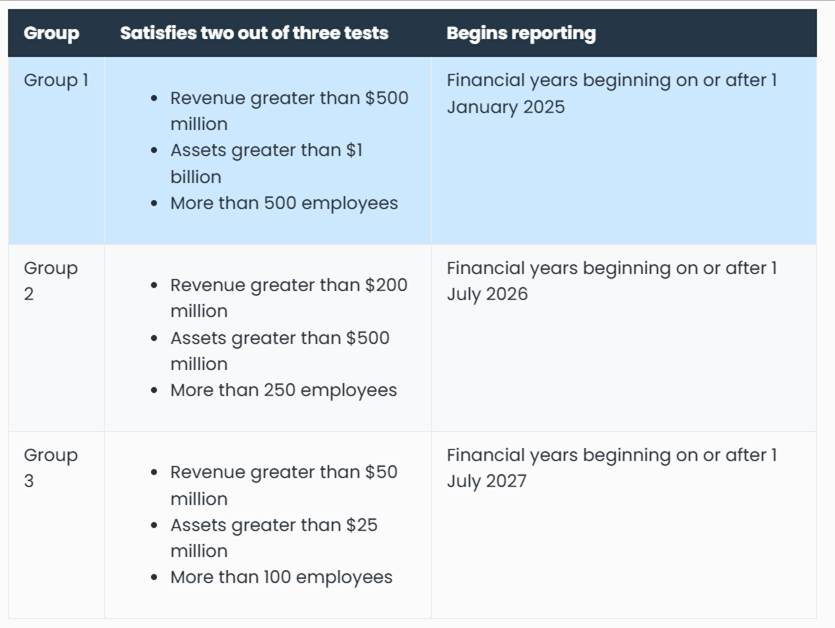
Whilst Group 1 companies are at the larger end of town, MGI South Qld works with a number of Group 2 and Group 3 companies that will be impacted by this legislation.
Mandatory climate reporting: what is required to be included in a Sustainability Report?
These companies are required to provide a sustainability report from financial year 2027 and 2028 for Group 2 and Group 3 entities respectively. This report should include:
- A climate statement
- Notes to the climate statement
- Directors’ declaration
Climate Statements must include information on climate-related risks and opportunities in line with AASB S2 – Australian Sustainability Reporting Standard. This requires information to be provided on the following:
- Material climate-related financial risks and opportunities faced by the entity (if any);
- Scope 1, 2 and 3 Green House Gas (GHG)* emissions and any associated reduction targets;
- Any information about governance of, strategy of or risk management by the entity in relation to these risks, opportunities, metrics and targets; and
- An assessment of the entity’s resilience to climate-related changes, using scenario analysis.
*Scope 1 covers direct emissions from owned or controlled sources, such as Company -owned vehicles or industrial processes. Scope 2 encompasses indirect emissions from purchased electricity, steam, heating, and cooling. Finally, Scope 3 includes all other indirect emissions that occur in the value chain, such as those from suppliers or the use of products.
What is AASB S2?
AASB S2 requires entities preparing sustainability reports to only utilise all reasonable and supportable information available to them as of the reporting date, provided it can be obtained without undue cost or effort. Accordingly, when reporting Scope 3 GHG emissions, entities are not expected to provide exact data or detailed information that is unduly difficult or costly to obtain from other entities along its supply chain. ASIC has clarified that reporting entities are permitted to use estimation in measuring Scope 3 GHG emissions, and can use primary or secondary data or a combination, noting that accuracy of estimation may improve over time.
Scenario analysis will also be required to be carried out and reported against, for at least the following two scenarios:
- the increase in the global average temperature well exceeds the increase referred to in s3(a)(i) of the Climate Change Act 2022 (Cth) (the Climate Change Act) (being an increase well below 2°C above pre‑industrial levels). According to the explanatory materials, a 2.5°C or greater scenario would satisfy this requirement. ASIC has stated there is a risk that reporting entities will not be compliant if they use a climate scenario based on an increase that is less than 2.5°C; and
- the increase in the global average temperature is limited to the increase referred to in s3(a)(ii) of the Climate Change Act (being an increase of 1.5°C above pre‑industrial levels).
ASIC also provides additional guidance on the intent of the scenario analysis requirements, being: ‘to ensure that users have the benefit of information about the reporting entity’s climate resilience and material financial risks and opportunities relating to climate that are informed by a scenario that: (a) contemplates rapid global decarbonisation in the near term (lower global warming scenario); and (b) contemplates more pronounced climate impacts over the medium to long term‘
According to AASB S2, entities are not required to disclose commercially sensitive information about climate-related opportunities, ensuring they can protect economic interests.
What are you required to do with your Sustainability Report?
The sustainability report will need to be approved by the Directors, provided to members at an AGM and lodged with ASIC. This report will also be required to be audited.
How can we help you meet the Australian Sustainability Reporting Standards?
MGI South Qld audits a number of companies that will be impacted by the changes to the ASRS standards and has the skills and expertise to provide this additional auditing requirement in the future.
If your current audit provider is unable to provide this additional service, or you are simply looking to review your auditing requirements against the market, please contact us today for a complimentary and no obligation discussion about your auditing services.