Subscribe for Our Latest Resources
"*" indicates required fields

Every year in Australia, instances of fraud cost businesses hundreds of thousands of dollars, and these are only the ones we know about.
Fraud doesn’t just happen on a large scale. Fraud cases can be minor in isolation, but have a surprisingly large impact on your business’ finances if left unresolved over time.
Key fraud findings
A recent report by auditors MGI indicated 47 per cent of Australian organisations experienced in excess of 10 fraud incidents in the past 24 months.
51% of all corporate frauds that occurred in 2015 were committed by internal fraudsters.
MGI Audit Manager Stephen Greene said it was concerning that economic crimes in Australia continued to increase and is higher than the global average.
“In the last 12 months we have seen clients uncover incidences of accounting fraud, fraud by trusted people within senior management and external fraud,” Stephen said.
“In some of these instances the fraud went undetected for multiple years and accumulated to a significant cost to the business,” he said.
What can businesses do to protect against fraud?
The good news is that there are certain strategies that businesses can adopt to reduce the likelihood of fraud going unnoticed within their business.
MGI has released a report that analyses specific cases of fraud in 2015 and provides key strategies that can implemented by businesses to deter and detect similar fraud situations.
To download the full MGI report click here.
If you are considering selling your business, either now or in the future, it’s important that you understand how to value a business for sale.
The challenge for many small business owners is that emotions often play a big part in their assessment. And that’s often for good reason: a passion for whatever it is that the business makes or does, a commitment to the industry sector, or a happy way of working.
But business owners can sometimes allow their emotional investment in the organisation to cloud their financial judgement.
It’s a useful exercise to weigh up your business as just another investment that needs to make a return on capital. After all, if capital wasn’t in your business it could be invested elsewhere.
Known as the Capital Asset Pricing Model, you begin with determining a ‘risk-free rate’.
Generally you take a 10-year government bond rate (currently about 3.5 per cent) as a surrogate for a risk-free rate.
So, if you’d say your business is more risky than a risk-free rate, you’d need to achieve a rate of return higher than 3.5 per cent.
Then, if you were to invest in a broad portfolio of publicly-traded blue chip stocks, you could expect a return of between 6-8 per cent above the risk-free rate, which would be about 10-10.5 per cent (assuming a risk-free rate of 3.5 per cent and an average portfolio return of 7 per cent).
The rate of return of an owner of one business in one industry in one city, that’s not publicly traded, should be significantly higher than that so you’ll need to calculate how much more risky your business is compared with a broad portfolio of blue chip stocks.
While there are endless measurements and calculations that can be made when looking at how to value a business for sale, it’s not necessary to get “too pedantic”.
Pick a figure that’s the appropriate benchmark for your business. Let’s say it’s 20 per cent. So if you’re actually getting 2 per cent, you know you’ve got some serious work to do to improve the value of your business.
Most business owners can tell you the dollar profit they’ve made. Often they’ll say: ‘That’s a 10 per cent return’, and when you quiz them further and ask 10 per cent on what? They’ll say, ‘On my sales’.
So they might have had sales of $10 million at a profit of $1 million but that’s just one part of the equation – the profit and loss – not the balance sheet.
Every business is fundamentally the same. It’s a pot of money made up of equity funding (your own money you’ve invested) and debt funding (money you have borrowed from the bank, bank overdraft, lease equipment etc).
Then you give your customers credit terms (accounts receivable/debtors), you invariably have stock you invest that money in (you’ll get credit terms from your suppliers, so you’ve got to take off creditors); you may have some plant and equipment that you need; and you may have bought some goodwill. That’s your pot of money.
So when looking at how to value a business for sale, what you need to be measuring your profit against is that pot of money, not your sales. You don’t say I made $1 million in profit and $10 million in sales therefore it’s 10 per cent. That’s the wrong thing to look at.
Some of our clients are achieving a return on capital of as much as 90 per cent.
When a business owner understands the concept of the pot of money and they can see that if they reduce the size of their pot – in other words, the amount of capital invested in the business – and keep their profit the same, then the return on their capital goes up.
The valuation multitude that someone will pay to purchase your business is dependent on risk i.e. how likely is it that your business will continue to produce the same level of revenue and profit in the years to come. The following comes into play when assessing this risk:
Generally a prospective buyer will pay between 1.5 and 3 times the return on capital.
The first step is to understand your current return on capital and then to come up with a plan to improve this. The second step is to address any risks in your business that might act as a deterrent to prospective buyers.
MGI South Queensland has a team of experts ready to help you understand how to value a business for sale. Contact our business valuation services team in Brisbane or the Gold Coast for assistance today or download our business valuation guide to get a head start.
The economic challenges of the last few years have brought with it a never-ending number of corporate collapses. I was recently asked why businesses fail. Is it the time of year? Is it that businesses are growing too fast and did this come down to the ego of the owner or chief executive? Or is it that management just doesn’t get it? My answer was, yes to all of the above. Let me deal with each of these.
I think it can be the case that for some businesses the run-up to Christmas is their best time for sales. This brings with it the wish or hope that “if we can just get through Christmas everything will be OK”. Unfortunately, unless the fundamentals of the business are sound, the festive season’s trading doesn’t end up being the panacea that may have been hoped for.
If a business looks like a dog, behaves like a dog and barks like a dog – then it’s probably a dog, no matter what time of the year.
As the saying goes – turnover (sales) is vanity, profit is sanity and cash flow is reality.
Unfortunately, based on my 30 years’ experience, sales growth can often be driven by the ego of the owner or chief executive. Here’s how – “look how good I am”, “we’ve doubled sales in three years”, “business is booming” – all mindsets that feed the ego. And this is fed by the media, with a growing stream of stories about this month’s fast-growing business, only to be next month’s corporate collapse.
What many of these businesses fail to realise is that a fast-growing business is in dangerous territory. There is often a focus on growing the top line (sales). There is less focus on whether the business is profitable and even less focus on how the growth is going to be funded – the cash flow.
Fundamentally, there is only one reason businesses fail – they run out of cash. You can have all the sales you like, but if you don’t have cash you’re out of business. There seems to be this mistaken belief that sales growth will magically fund itself.
A business owner said to me recently: “You know, we don’t know what we don’t know.” What he meant was that he was blissfully unaware of the key things he needed to know in order to run a successful business.
He had no idea whether his business was performing well. He had no key business performance metrics on which to assess performance. Clearly not all businesses are like this but it begs the question whether failed businesses are measuring and managing the key aspects of their business.
As mentioned previously, there is only one reason businesses fail – they run out of cash. There are three reasons they run out of cash – they grow too fast, they use operating working capital to buy long-term assets (e.g. plant) or they simply aren’t profitable. The key is to ensure you don’t fall into one of these three categories by undertaking good business hygiene.
The sad part is that in the vast majority of cases, business failure can be prevented if owners and chief executives focus on a few key parameters. Here are my key parameters to prevent your business becoming a statistic:
If you aren’t being provided with this information and managing it properly, you’re flying blind.
Grant Field works as a business advisor with a number of high growth companies assisting them to achieve a sustainable high growth performance. For more information on our business advisory or accounting services please contact us.
This article has been modified from the original in August 2023 and originally appeared in The Sydney Morning Herald, The Age, WA Today, Canberra times and Brisbane Times.
I’ve often been asked by clients to assist in a trade sale of their business or a sale or hand over to the next generation. These all take different forms depending on the motivation of the parties concerned. While there seems to be an increasing awareness of the need to prepare for transitioning the business, figures from the latest MGI Family Business Survey indicate that more than 75% of family businesses have no formal, written management or ownership business succession planning process.
I was recently asked what I thought were the secrets to good business succession for a family-owned business. A common scenario is where the mum and dad business founders want to retire and hand the business over to one or more siblings.
As in life generally, communication is the key. Differences can arise when the parties have a mistaken perception about the motives and actions of each other. Talking things through is therefore critical to avoid the potential for the parties to make assumptions and jump to sometimes erroneous conclusions.
Of course, having a framework to work through the process is vital but one thing you cannot predict is how people will react – their thoughts, feelings and concerns. Taking account of the human side of the planning process and having a process to deal with it is critical to the effectiveness of the final plans.
Creating an effective business succession plan may seem quite a daunting task, especially when it involves getting the buy-in of all family stakeholders but if you break it down into bite sized chunks and set realistic deadlines for yourself, it can prove to be one of the most valuable exercises you will undertake for your business.
it is important for you to start planning your succession now. A business coach and advisor from MGI South Qld can help you start the process including helping you benchmark your business against others in the market, strategic planning planning, wealth management and business valuations.
Our succession planning services will help you make calm and considered decisions about the long term future of your business.
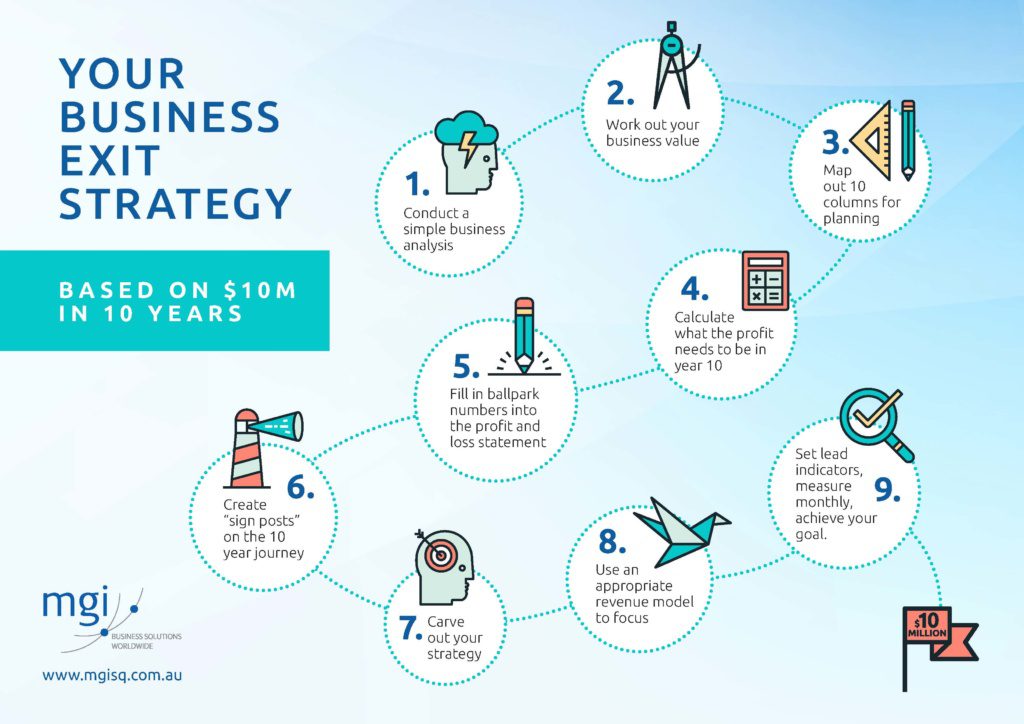
You might also be interested in our previous blogs about business exit strategy and why it’s important to start the business succession planning process now
In over thirty years advising family businesses, the most successful succession plans I’ve seen have been the ones where there was solid stakeholder engagement – in other words – good communication within the family. Even if you think everyone is aware of what is going on and generally on the same page, don’t leave things to chance for people to fill in the blank spaces. Fill them in for them.
Often there will be an “heir apparent” to the family business – someone that has worked in the business already. But do you really know the personal (and business) vision of all family members? Have you taken the time to talk to ALL family members to ensure they’re on the same page? The risk of not doing so is a potentially unhappy sibling which could lead to a lifetime of bitterness and resentment.
A good place to start is to actually ask all family members about their personal vision.
When talking with business owners I like to obtain the above information by way of a succession planning questionnaire and have each family member complete this. If you intend to have multiple family members owning the business, make sure there is cohesion around investment decisions and dividend policy. In my experience, this is where things can go awry. Let me give you an example.
Sibling one sees the future potential of the business. They want to grow it and invest all of the profits back into the business for the strategic growth of the business. Sibling two is also happy to grow the business, but wants (or needs) the monthly dividend cheque in order to fund their lifestyle. You can see that the disconnect between the personal (and business) visions of each sibling will end up as a recipe for disaster.
Another of the potential areas for disagreement and resentment can be if one sibling feels another sibling has got something unfairly. In other words, if one sibling feels another sibling has been “given” the business or at a significant discount.
So, make sure there is total transparency in relation to price. Get the business valued by an independent party so that everyone knows that a market price has been paid, even if most or all of this is vendor financed by the parents transferring the business.
As in any relationship – communication is always the key. Our succession planning services will help you make calm and considered decisions about the long term future of your business.
Just like in our own household, waste costs the average family business tens if not hundreds of thousands of dollars every year. However, the business owner doesn’t just incur the yearly cost, but the multiple of that cost when a business is sold. So how do you identify and reduce business waste to grow your bottom line?
Let’s assume that through a waste audit we can identify $100,000 in yearly cost savings in your business. Let’s also assume that you’re getting close to selling your business. As businesses are generally sold for a multiple of earnings (i.e. profit), it follows that if you can cut $100,000 in costs, then you’ll increase profits by the same amount. If the business is sold for say five times profit, then that’s a cool half a million dollars in your back pocket – certainly nothing to be sneezed at!
Reducing waste may not sound overly exciting, but it can pay real dividends. And a point to remember: this is money that is coming straight out of your pocket!!!
I use activity based costing (ABC) as a means to explain what I mean by waste. ABC is a simple concept. In any business, people do things, whether this is loading a truck, operating a machine, using a computer. This is called ‘Activity’. In the course of “doing things” scarce resources are consumed e.g. the person’s time, the cost of the machine etc. Each of these has a cost, whether it be the wages of the employee or the operating costs of the equipment. ABC is about allocating the cost of those resources to cost objects. This could be a particular product or service.
So, whether we like it or not, these costs are embedded in the products or services businesses sell. If the cost of your product or service is not competitive in the marketplace, think about undertaking a waste audit. It may enable you to reduce your costs and become more competitive.
Over the years I’ve worked with many businesses to identify waste. I work through a process to identify and quantify waste in each of the above areas. We then assess this against the ease of fixing the problem. We start with the bigger the potential cost savings that are the easiest to fix.
In my experience, it is only once you get on the “waste train” and embrace it, that it stands out and becomes easier to identify. It’s as if a light bulb goes on in the mind of the business owner. The “penny drops” and a whole new mindset takes hold.
If you’d like an external review of your business to identify how you can reduce business waste and start to grow your profits even further, let me shout you a coffee and have a chat.
There’s an old saying – profit is opinion, cash is fact. That’s because despite making a profit, some businesses still don’t have enough cash to pay the bills. At the end of the day, a lack of cash will kill a business.
Since the GFC, banks have been paying increased attention to the cash flow position of their business customers – more particularly ‘free cash flow’. So what is free cash flow?
Regardless of size, the principles of running a business are the same. Simplistically, a business is just a pot of money. That “pot” gets invested in holding Stock, providing credit to customers (Debtors) and acquiring Plant & Equipment. In return, the business usually gets credit from its suppliers (Creditors). Each year as the business grows so does the size of this “pot” – more stock, more debtors and more plant and equipment.
The increase in the size of the pot has to be funded from one of two sources – debt or equity. Usually, it is funded from after tax profits (or equity) and after payment of any dividends to the owners. If this profit is not sufficient to fund the increase in size of the pot then this results in negative free cash flow. Banks are concerned about this because if the extra funding isn’t coming from the business profits then it has to come from the bank or from new or existing shareholders (by way of increased share capital). For most privately owned businesses, the latter is usually not an option – which leaves the bank to fund the shortfall.
This means the growth rate of the business is not sustainable (sometimes called “over trading”). Whilst it may be okay for a year or two, eventually it will catch up with you. Over trading has ruined many potentially good businesses.
Apart from the level of stock and debtors blowing out, there are three real reasons why a business will feel the pinch on cash flow.
Some tips.
For many small business owners, superannuation can be a confusing and complicated place.
This needn’t be the case. It is best to break things down into various “buckets” and tackle them one at a time.
If you would like to learn more about how to get the maximum benefit from your superannuation, or how to make managing your superannuation easier, register for our free upcoming breakfast Smart Super Strategies: How to get more from your biggest long-term investment.
Super Contributions
There are yearly dollar limits on the amount that members or member’s employers can contribute into super. Contributions in excess of these limits attract the top marginal tax rate of 45%, so beware.
These limits are broken into two components – concessional contributions and non-concessional contributions. The former are simply contributions for which the member or employer (whoever makes the contribution) obtains a tax deduction. For those under 49 years of age, the limit is $30,000 and it’s $35,000 for those over 49 years of age. Non-concessional contributions are those contributions for which the member doesn’t obtain a tax deduction. These are unaffected by a member’s age and the yearly limit is $180,000 or the member can elect to “bring forward” up to three year’s contributions, meaning they can contribute up to $540,000 provided they have not exceeded the $180,000 cap in any of the previous three years. The member will also not be able to make any further contributions (above the $540,000) for the next three years.
Super Rules
There are a range of provisions regarding what a super fund can and can’t do, particularly in relation to self-managed super funds (SMSF’s). Here are some examples of rules impacting SMSF’s. The overriding “rule” is what is referred to as the sole purpose test. This simply means that the fund must be established and maintained for the sole purpose of providing superannuation benefits to members. There are then some very specific rules.
In-house assets
As the name suggests, these provisions mean that a super can’t make loans to, or investments in, a related party or entity unless that loan or investment is less than 5% of the value of all of the assets of the super fund. This also includes an asset of the fund which is leased to a related party unless this is business premises.
There are then a whole series of tests to determine whether someone is a related party.
Similarly, a SMSF can’t lend to a member or relative of a member.
Acquiring assets from members
As a general rule, a SMSF cannot acquire an asset from a related party of the fund unless the asset is business premises or listed shares. Any such transaction would need to be at market value.
Borrowing
Again, broadly speaking a super fund cannot borrow money except in certain specific defined situations. These include short term funding (i.e. less than 90 days) to fund superannuation payouts and limited recourse borrowing arrangements (LRBA’s).
The use of LRBA’s can be used to great effect by small business owners and this is discussed in more detail below.
Super Penalties
It is important to realise that breaches of the above rules (and other rules) by a fund trustee could render the trustee liable to a range of potential fines by the ATO. These fines range from $850 up to $10,200 and importantly, they can be levied on each trustee. So a typical “mum and dad” fund where both are trustees could mean total fines of double the above numbers. For this and other reasons, many SMSF’s are replacing “mum and dad” trustees with a corporate trustee.
In extreme cases, where the fund trustee has blatantly disregarded the regulations, the ATO can disqualify a person from acting as trustee of a fund and/or remove the fund’s complying status which can have disastrous consequences. Basically, loss of complying status means that all assets of the fund are taxed at the top marginal rate of 45%. For example, a fund with assets of say $500,000, would have to pay tax of $225,000, leaving only $275,000 left in the fund. In addition, for every year that the fund remains non-complying, its income is also taxed at the top marginal rate.
There are also potential criminal penalties for the breach of certain superannuation rules.
Super Opportunities
Notwithstanding the above, SMSF’s provide significant opportunities, particularly for small business owners.
As mentioned above, a SMSF can acquire business premises from which the business owner operates their business, provided a market rental is paid. The super fund can also borrow (using a LRBA) to fund the purchase of the property if needed. It is important to note that there are strict requirements for LRBA’s and readers should seek professional advice prior to undertaking this.
It is also not too late if the business premises are already owned by “mum and dad” through another entity. The property can be sold to the super fund and there may be significant tax benefits in doing so, notwithstanding that stamp duty may be payable on the transfer. For example, the business may be operated through a company or trust, with a tax rate of 30% or more. By paying rent to your super fund, you get a tax deduction for the rent expense at 30% (or more) but the fund only pays tax on the rental income it receives at the rate of 15%, so there is a net tax benefit to the business owner equal to 15% of the rental income each and every year. If the fund is in pension phase (i.e. paying pensions to its members) then the fund pays no tax on the rental income it receives and the business owner pockets the whole 30% (or more) on the rental income paid each and every year.
In addition, even if the fund is not in pension phase, when the property or any other asset is sold, the capital gains tax rate inside a super fund is only 10% compared to up to 22.5% outside of super. Once again, if the fund is in pension phase, the CGT rate inside the fund is zero. So there are significant advantages in accumulating as much wealth as possible inside super.
Another potential advantage relates to the super fund investing in public company shares. Most dividends received will be franked dividends (i.e. tax paid at 30%). These are only taxed at 15% in super, so the balance of the franking credits are available as a tax refund to the fund or can be used to offset other tax payable. Where the fund is in pension phase, and the fund pays no tax, all of the franking credits would potentially be available as a tax refund.
Why talk to us?
Managing your super fund, and navigating the minefield of rules and regulations, can be a stressful and time consuming activity. MGI can help you maximise the opportunities that superannuation benefits present. Register for our upcoming Smart Super Strategies breakfast held on 3 September or talk to us today and begin the journey to achieving the lifestyle you want in retirement. Call our Brisbane office on 07 3002 4800 or our Gold Coast office on 07 5591 1661.
Barriers to succession I’m often intrigued when I read in the press about rather large family-owned businesses which are impacted by family and succession issues. Someone commented to me recently about the issues surrounding Bob Jane’s family and his business and how these have been in the media in recent years. I was asked: “Why do these types of issues arise in quite large businesses? Are they common and do they occur in all family businesses?” Firstly, family disputes are nothing new. They have been going on for thousands of years. However, when you overlay family relationships with business you have a unique dynamic.
As with any relationship breakdown, the breakdown of a family business relationship usually occurs due to a lack of communication between the parties. I’ve previously published my top 5 tips for successful family business succession. The first two of those tips related to communication.
By way of background, we know from the recent MGI Family & Private Business Survey that the average age of a family business owner is 58 and this has increased on surveys over the past decade. Over a third (37%) are aged between 60 and 70, with 25% aged over 65. Interestingly, the survey also found that nearly 60% of family business owners felt that the younger generation family members are not as interested in actively managing the family business.
In a sector that employs over 60% of employees and is estimated to be worth some $4.1 trillion nationally, family business succession is a crucial issue facing the Australian economy.
Firstly, I think it is important to identify what we mean by succession. In relation to a business, there are a number of areas of succession, but the two most common are management succession and ownership succession.
Whilst some issues spread across both means of succession, I believe that greater clarity can be achieved by looking at these issues separately. For example, there is no reason why parents cannot retain ownership of the family business but handover operational management to the next generation. In this scenario, difficulties arise if, for example, the parents won’t “let go” of operational matters. In family and private business, business owners often wear three “hats”:
Sometimes these roles get blurred and when they do it is not always apparent which “hat” the person is wearing. So a useful first step is to understand and agree whether a business is dealing with management succession, with ownership succession or with both.
According to the MGI Family & Private Business Survey, around 60% of family businesses are first generation businesses.
It makes sense to assume then, that most family-owned businesses won’t have dealt with this area before and in my experience, the biggest reason these issues are not addressed is that most business owners just don’t know where to start. Many also say that they don’t want the business side of things to impact on a close family relationship. This is perfectly understandable but also quite manageable.
However, sometimes these issues are swept under the carpet in the interests of family harmony. In my view, this is just putting off a problem to another day – a day when the problem may be much bigger, and harder, to deal with.
Suffice to say, in my experience, the likelihood of successful succession planning can be enhanced by both using an external party to facilitate the discussions and following a process. If this is done effectively, the likelihood of conflict between family members can be significantly reduced and managed.
In any family business, the motivations and aspirations of the various family members will be different. I find that one useful exercise is to have the family members complete a simple survey designed to identify what it is each of them are looking for out of the business.
Our succession planning services will help you make calm and considered decisions about the long term future of your business.