Subscribe for Our Latest Resources
"*" indicates required fields

The Business Growth Fund Program (BGF) targets high-growth businesses who can accelerate growth, drive Queensland’s economy and employ more Queenslanders. The program is administered by the Department of Employment, Small Business and Training (DESBT).
Small and medium-sized businesses that employ 5-49 people (headcount).
Interested businesses will be invited to submit an expression of interest from 9am on Wednesday 1 May.
Businesses with high-growth plans should review the guidelines and eligibility criteria for the upcoming round of the Business Growth Fund program.
This program offers grants of $50,000 to $75,000 to support the purchase of specialised equipment as a co-contribution with eligible businesses.
Successfully funded businesses are expected to:
Expressions of Interest (EOI) are now open.
The application process involved 3 stages:
Expressions of Interest close: 5pm Tuesday 14 May 2024.
Please contact the team at MGI if you have any questions or require further information.
Following on from our post a couple of months ago about tax and superannuation deadlines the following are the upcoming contribution cap and superannuation changes.
1. Contributions – cap increase
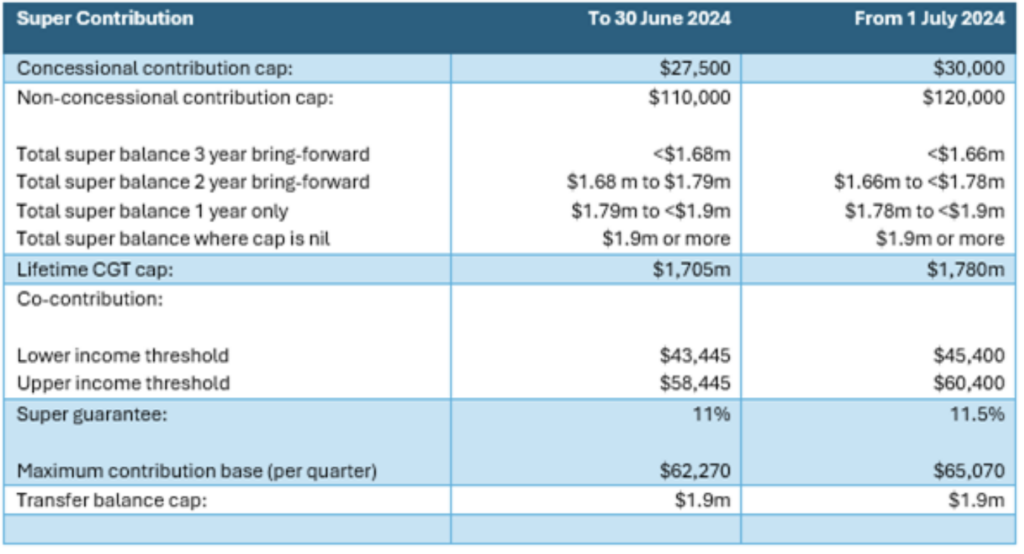
From 1 July 2024 a number of rates and thresholds will increase, including the contribution caps. There has been no further indexing of the transfer balance cap so there will be changes to the eligibility to use the 3 year bring forward non-concessional contributions (see table below).
A reminder to review any salary sacrifice agreements to avoid excess concessional contributions with the increase in super guarantee to 11.5% from 1 July 2024.
2. Defined benefit interest (CSS/PSS) calculation for Division 296 – in relation to superannuation balances above $3million
From 1 July 2025 tax concessions will be reduced for certain earnings for superannuation balances above $3 million. On 28 February 2023, the Australian Government announced from 1 July 2025 a 30% concessional tax rate will be applied to future earnings for superannuation balances above $3 million, known as Division 296.
If you are wondering how the balance of your CSS or PSS pension will be calculated for the purposes of the proposed Division 296 tax you will need to wait a little longer.
While draft legislation has been released, the calculations for determining the balance of defined pensions will be contained in the regulations which no one has seen (or possible written).
3. Reminder about the changes in Small Business Super Clearing House
From 15 March 2024, the ATO will introduce SMSF bank account validation in the Small Business Superannuation Clearing House (SBSCH). This will require any small employer using the SBSCH to ensure that their employees’ SMSF bank accounts match the bank account details registered with the ATO for contributions.
If you are receiving contributions via SBSCH or using the SBSCH to pay employer contributions, it is important to contact employees to confirm that the SMSF bank account that superannuation contributions are paid to, is the same as the SMSF bank account registered against the superannuation role, with the ATO. A mismatch will mean that their superannuation contributions can’t be processed through the SBSCH.
This also applies for any member roll-in and roll-out requests.
Please contact us if you need to check the details of the bank account registered with the ATO for your SMSF.
Proactive steps are essential to ensure any SG obligations for the March 2024 quarter can be met by 28 April 2024.
4. Non-Arm’s Length Income/Expense (NALI/NALE) Bill Passed Through Parliament
An important reminder to the trustees and the members of the fund, that NALI/NALE bill has now passed through both houses of Parliament and it is essential to review all general expenses incurred/not-incurred within the fund.
It is crucial to understand and review transactions within the superfund that there is no expenditure at non-arm’s length that will trigger the rules concerning non-arm’s length income.
This rule specifically dives into general expenses such as discounted accounting or adviser fees, legal fees or any other general expenses which are non-arm’s length.
If you have any queries or concerns or need further advice and support about superannuation changes please don’t hesitate to reach out to the team at MGI.
Personal Services Income can be a confusing topic, particularly if you’re a sole trader. However, it’s vital to understand what it is so you know what tax deductions you can claim. Personal Services Income (PSI) is a concept introduced by the Australian Taxation Office (ATO) to govern how income from personal services is reported and taxed. PSI is particularly relevant for independent contractors, freelancers, and consultants who provide their professional or technical expertise. The ATO’s guidelines around PSI help ensure that individuals who earn a significant portion of their income from their personal efforts or skills pay the appropriate amount of tax. So what is personal services income? In this blog we’ll explain the PSI rules, outline how it is calculated and explore its impact on tax deductions.
Personal Services Income refers to income that is primarily generated from your personal skills or efforts as an individual. According to the ATO, income is classified as PSI if more than 50% of the amount you received for a contract was for your labour, skills or expertise. The concept is usually applicable to knowledge-based services such as:
However, it doesn’t apply if your income is generated from the use or sale of a product, the use of an income-producing asset or other business structures involving more than just personal effort.
Jayne is a marketing consultant operating as a sole trader. She has two clients who she has recently completed work for.
Client 1: Jayne delivered a Marketing Strategy training session for her client. She charged the client $1,500 for the session which included materials that cost $150. That means that $1,350 or 90% of the work was for her personal skills and knowledge and should be classified as PSI.
Client 2: Jayne provided email marketing software for a client for which she charged $5,000. The cost of the software licence was $4,000 and the remainder was for her skills and expertise in setting up the software for the client. Since only 20% of the cost was for her expertise, this is not classified as PSI.
While your taxable income can be a mix of PSI and non PSI you should establish whether you are a personal service business (PSB) in the year that you received the PSI income as this affects the deductions you can claim.
The PSI rules are in place to determine how income is reported and what deductions are permissible. The purpose of these rules is to prevent individuals from diverting their income through companies, partnerships or trusts to exploit lower tax rates. Essentially, if the PSI rules apply, the income is treated as personal income and taxed at individual tax rates.
To determine if the PSI rules apply to you, the ATO applies a series of tests:
If you fail these tests, you need to treat your income as PSI and comply with the relevant tax implications.
The Personal Services Income (PSI) rules were introduced by the Australian Taxation Office (ATO) to address tax avoidance issues associated with the income earned primarily from the personal skills or efforts of an individual. Essentially the rules ensure that contractors pay similar amounts of tax as those who are employed, preventing them from gaining tax advantages by diverting their income through companies, trusts, or partnerships. The PSI rules now prevent the misuse of business structures for the purpose of tax minimisation.
Before the PSI rules, individuals could reduce their tax liability by channeling their income through such entities. These entities would then potentially claim deductions that would not normally be available to an individual, or split income among various members to reduce the overall tax rate. This approach could substantially lower the tax obligations compared to what an individual might pay if taxed at personal income rates.
Calculating your PSI involves identifying all income received from personal efforts and applying the relevant PSI rules to determine your taxable income. If the PSI rules apply, you will need to attribute all income and deductions to yourself, regardless of whether your business structure involves other entities.
The PSI determination directly influences how you claim deductions. Generally, deductions are allowed for expenses incurred in generating PSI, including:
However, certain deductions, typically available to businesses, may not be claimable if they do not directly relate to the earning of PSI. These may include rent, occupancy expenses, or salaries paid to associates who do not contribute directly to contract fulfilment.
For professionals and freelancers, understanding PSI is crucial to ensuring compliance with ATO guidelines and optimising tax obligations. Here are the main points to remember:
By understanding and adhering to the PSI rules, individuals can better navigate their tax obligations and plan their financial affairs accordingly. For further guidance, consulting a tax professional or visiting the ATO’s website can provide additional clarity and personalised advice.
This overview should serve as a starting point for anyone dealing with PSI and aiming for a compliant and optimised tax handling of their personal services income in Australia.
If you require assistance with understanding your tax obligations and ensuring you claim the correct tax deductions, our team of expert business tax accountants can help.
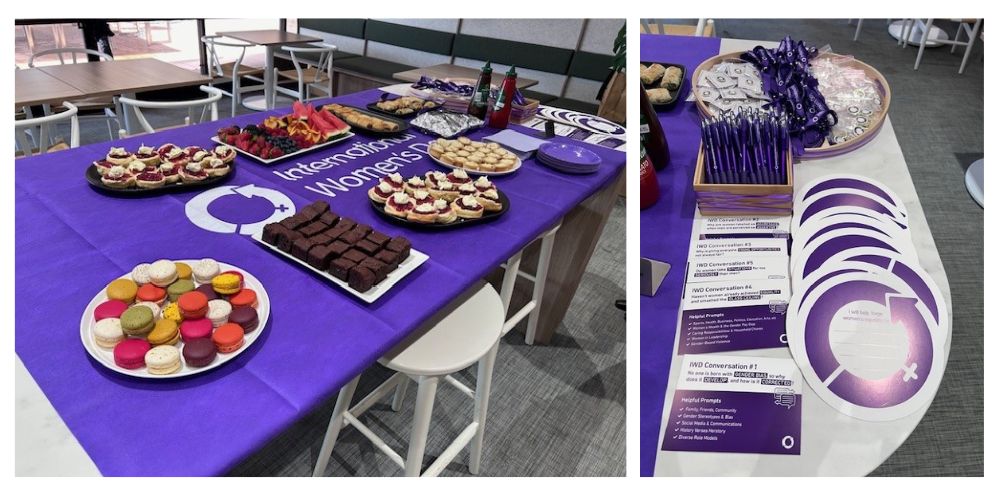
Today at MGI, we celebrated International Women’s Day 2024 with this year’s theme ‘Inspire Inclusion’. As we know, March 8th is an annual focal point in women’s rights around the world to focus on important issues including gender equality, reproductive rights, violence and abuse against women.
To inspire others to understand and value women’s inclusion is to forge a better world for their belonging, relevance and empowerment. MGI embraced this years’ theme colours purple (justice & dignity), green (hope) and white (purity) and took time to reflect on the achievements of our female staff and their important contributions to the success of our firm with a scrumptious morning tea.
To help you plan, we have included the important upcoming superannuation and tax deadlines and dates as a reminder.
31 March 2024 – Large tax payers (Turnover > $2Million) 2023 Tax Return lodgement and payment due date
For Companies or Superfunds that had a turnover of more than $2Million in their prior year’s tax return, your 2023 Tax Return is due for lodgement and payment 31st March 2024. If you feel that you will have any difficulty in making your 2023 tax return payment, please contact MGI to discuss your payment options.
15 May 2024 –2023 Tax Return lodgement and payment due date
For the majority of tax payers, the 2023 Income Tax Return is due for lodgement and payment by 15th May 2024.
If you are an MGI client and have not yet provided us with your 2023 tax work information, please don’t hesitate to contact us to discuss what information we require to complete your annual tax work, alternatively please don’t hesitate to send through your information directly to your MGI contact and we will let you know what further information we may require. MGI will be touching base with our clients to request your annual tax work. This due date is still a few months away, however if your 2023 tax work has not yet been started, please reach out to us to get your work scheduled for completion within the next few months.
If we have already completed your 2023 annual tax work, can you please ensure that you have returned the signed documentation back to our office for filing so that we can lodge your returns by this due date. If you unfortunately have to make a payment to the Tax Office, that payment due date is also 15 May 2024. If you feel that you will have any difficulty in making this payment by this due date, please don’t hesitate to touch base with us to discuss your payment options.
31 March 2024 – 2024 FBT year-end date
The FBT year runs 1 April – 31st March, if you are an FBT client we will be touching base with you in late March 2024 to discuss your FBT requirements and to start on requesting information with respect to the completion of your annual FBT returns. Don’t forget to record your vehicle speedo readings as at 31 March 2024, which is a requirement from the ATO for business clients to keep records of.
The 2024 FBT Return payment and lodgement due date is 25 June 2024, however to ensure we have ample time to complete our client’s returns before this due date we will be touching base as early as possible so please keep an eye out for correspondence from our office with respect to your FBT lodgement requirements.
April – June 2024 – End of Year & Tax Planning
We will be touching base with our Tax Planning clients in early April to get started on our annual tax planning process. Tax Planning is very important as it can help make you aware of you upcoming tax liabilities and also gives you an opportunity to implement strategies that can help you reduce your tax implications. The earlier we are able to complete your tax planning the better, as this gives you ample time to review your options and implement any strategies before 30 June. As such, we do ask our Tax Planning clients to have their year-to-date information (1 July 2023 – 30 April) up to date in their accounting software so that we can complete our tax planning calculations when the time comes.
30 June 2024 – Deadline for Employee Superannuation Payments
Employee Superannuation is tax deductable when it is paid and only if paid on time. Superannuation must be paid at least quarterly by the following due dates:
If you are wanting to maximise your Superannuation deduction for the 2024 Financial Year, you will need to make any June 2024 quarter payments before 30 June 2024.
The above tax deadlines are only general reminders, but if you have any queries or concerns, please don’t hesitate to reach out to the team at MGI. Also take a read of our recent blog on the ATO’s areas of focus for 2024.
Storm-ravaged tourism businesses on the Gold Coast will receive a further $2.5 million in support funding from the Queensland government. 50,000 vouchers, each worth $50 will be available for use at Gold Coast tourism businesses.
Some tourism businesses are still closed due to damage caused during the deadly Christmas and Boxing Day storms. Deadly storms battered south-east Queensland on Christmas Day and Boxing Day, claiming seven lives and leaving tens of thousands of homes and businesses without power. Tourism attractions across the region were heavily impacted, with some still closed due to the storm damage.
Premier Steven Miles has announced that 50,000 vouchers, each worth $50, would go on offer to stimulate the Gold Coast’s tourism economy.
If you spend $50 on a day tour or attraction taking part in the scheme you will receive an extra $50 credit. It means a $100 experience will put you out of pocket by $50.
Tourism and Events Queensland chief executive Patricia O’Callaghan said vouchers had been proven as a way of helping tourism businesses across the state during the COVID pandemic. She said they had proven benefits in the short- and long-term.
Premier Steven Miles said south-east Queenslanders could access one of the 50,000 vouchers through the GC Summer FUNds website but it is yet to go live.
The vouchers, when you can sign up, will be available for use until the end of March.
For more information about the stimulus, visit the Queensland Government website.
If you have any questions or need assistance with your application, please contact the team at MGI South Qld.
As a business owner, navigating the financial landscape and understanding the available grants and incentives can sometimes seem like steering through uncharted waters. A lack of knowledge about the potential financing options is a common hurdle that many encounter. However, one well established program that is often overlooked is the research and development tax incentive. The scheme, also known as the r&d tax incentive or the R&DTI, is non-competitive meaning you just have to meet the criteria to be eligible to apply. So let’s take a look at the r&d tax incentive and answer some of the key questions.
The R&D Tax Incentive is a flagship Federal Government program designed to boost competitiveness, innovation and drive economic productivity and encourage Australian companies to invest in research and development activities. The key aims are:
This tax incentive is not industry-specific, meaning that businesses from a wide range of sectors can leverage this benefit. It offsets some of the costs of research and development activities and aims to reduce some of the financial risks associated with undertaking this activity. This can be crucial for businesses who are keen to test new approaches but are uncertain about whether the long term gains of exploring new products or services can justify the costs.
By providing generous tax advantages to firms carrying out eligible R&D activities, the program helps lighten the financial load associated with undertaking such work. The key objective is to stimulate an ecosystem that nurtures inventiveness, pioneering business approaches and overall economic progression.
The incentive works by providing a tax offset for certain expenditures incurred in R&D activities. The offset rate, however, varies according to your business’s aggregated turnover and is now based on a premium on top of your corporate tax rate.
For smaller companies with aggregated turnover of less than $20 million, the refundable R&D tax offset is your corporate tax rate plus an 18.5% premium which equates to 43.5% for most companies in this bracket.
The offset can also be refundable so if your company tax liability is reduced to zero you can access a cash refund for any unused offset amount.
For larger businesses with an aggregated turnover of more than $20 million, there is a two tier system based on their research and development expenditure as a proportion of their total expenses. This is referred to as R&D Intensity.
While they cannot access a cash refund for any unused offset amount if the tax liability is reduced to zero, it can be carried forward to future income years.
It’s important to note that these offsets are subject to annual limits and other conditions set by the Australian Taxation Office (ATO) and AusIndustry.
Many business owners wrongly assume that the R&D tax incentive is only available to businesses involved in scientific research or laboratory work. However, in reality if, for example, you operate in the manufacturing, IT, software development, agriculture, engineering, mining or biotechnology sectors, this program could present a great opportunity to grow your business.
To be eligible for the R&D Tax Incentive, businesses must:
1. Be an Australian Resident Entity: The incentive is primarily for businesses operating and paying taxes in Australia.
2. Engage in Eligible R&D Activities: These activities should be aimed at acquiring new knowledge, creating new or improved materials, products, devices, processes, or services. The activities must also meet the definitions of either Core R&D activities or Supporting R&D activities as defined by the program.
3. Incur Eligible Expenditure: This includes staff costs, materials, overheads, and some contractor expenses directly related to R&D activities.
4. Companies must register their eligible R&D activities with the Australian Taxation Office (ATO) before claiming the R&D Tax Incentive. The registration must be completed by the deadline specified by the ATO.
Applying for the R&D Tax Incentive involves a few steps:
1. Register Your R&D Activities: This must be done annually with AusIndustry within 10 months after the end of the income year in which the activities were conducted.
N.B. The window to claim the R&D incentive for the 2023 financial year closes on 30 April.
2. Submit a Tax Return: Include the R&D tax offset amount in your company’s tax return.
3. Maintain Records: Keep detailed records that demonstrate your R&D activities and expenditures are eligible under the program.
The R&D Tax Incentive is a powerful tool for fuelling growth, encouraging businesses to push boundaries, test new ideas and pioneer groundbreaking solutions. In a world where innovation is key to success, the offset could be the stimulus your business needs to stay ahead of the curve.
The R&DTI represents a vital opportunity for SMEs in Australia to advance their innovative projects while mitigating financial risks. By understanding and utilising this program, businesses can not only contribute to their growth but also to the broader advancement of technology and industry in Australia. It is advisable for SME owners to consult with tax professionals or R&D experts to navigate the application process and maximise the benefits of this incentive.
With expertise in accounting, tax, technology and business grants, MGI can leverage our expertise to support your business in understanding whether this scheme is right for you. As well as supporting our clients with all aspects of claim compliance and preparation, we also assist with reviews and audits associated with R&D Tax Incentive claims. Contact our Business Advisory team and let us shout you a coffee to discuss your business goals and whether you can benefit from this tax offset.
Queensland Government has announced disaster assistance, working capital Loans and freight subsidies for those impacted by the recent SEQ storms.
The Australian and Queensland Governments have announced further assistance for Queenslanders impacted by the SEQ storms on Christmas night.
Disaster Assistance and Essential Working Capital Loans are now available for affected small businesses, primary producers and not-for-profits in City of Gold Coast, Scenic Rim Regional Council and Logan City Council to assist with the repair and recovery of essential equipment, and for loss of income.
Freight subsidies are also being made available to primary producers to alleviate the costs of moving stock and operating materials.
Assistance is being provided through the joint Commonwealth-state Disaster Recovery Funding Arrangements (DRFA).
To access disaster loans or other activated assistance measures, you can apply with the Queensland Community Recovery Hotline (1800 173 349) which is available around the clock for questions on eligibility and how to apply. Visit Queensland Rural and Industry Development Authority for more information.
Up to $250,000 for producers and small businesses and $100,000 for not-for-profits to repair or replace damaged assets like plant and equipment, to repair premises, or to replace stock and maintain liquidity.
Up to $100,000 for primary producers, small businesses and not-for-profits to allow for the continuation of operations, including paying wages, rents or rates, purchasing items such as fuel, fodder and water, or for the transportation of livestock and produce.
Up to $5,000 for primary producers to assist with the movement of stock, feed, machinery, fuel, water, and building or fencing materials.
The joint statement by Federal Minister Murray Watt and State Minister Nikki Boyd highlights the support available and provides links to the relevant authorities.
If you have any questions or need assistance with your application, please contact the team at MGI South Qld.
Australian Government – Department of Health & Aged Care Grant Opportunity GO6625
This Historical Leave Liability Grant Opportunity will provide $130.9 million 2023-24 to fund Aged Care providers for 50% of the cost associated with paying higher leave entitlements for workers that have had their wages increased as a result of the Fair Work Commission (FWC’s) decision. Funding can only be claimed to ‘top up’ relevant leave entitlements that are directly attributable to the FWC’s decision of a 15 per cent wage increase.
Eligible leave liabilities are long service leave (recognised at the first full pay period on or after 30 June 2023), recreation leave (also known as annual leave) and personal leave (also known as sick leave).
Aged care providers include those that provide one of the following aged care programs:
Applications can only be accepted from Aged Care service providers that have increased staff wages as a result of the Government’s $11.3 billion investment to support increased wages for aged care workers, as part of the FWC’s decision.
Closing Date for Grant Applications is 31st of January 2024.
For more information on your eligibility as an Aged Care provider and the Grant Opportunity Documents visit the Australian Government Grants website
If you have any questions or need assistance with your application, please contact the team at MGI.
The $50 million Backing Business in the Bush Fund is an investment program to support Queensland small to medium enterprises (SMEs) undertake projects in regional Queensland.
The Treasurer and Minister for Trade and Investment, The Honourable Cameron Dick, announced that applications are now open for SMEs looking to expand into regional Queensland.
SMEs eligible for the grant must:
Activities that are eligible for the grant include those that focus on growing productivity and efficiency, employment and upskilling, and long-term sustainability and competitiveness.
Applications close on the 14th of January, 2024.
For more information on your eligibility and the application checklist visit the Queensland Government – Backing Business in the Bush Fund website.
If you have any questions or need assistance with your application, please contact the team at MGI.