

Do I need an accountant or financial advisor? It’s a question we get asked frequently. You want smarter money decisions, fewer surprises at tax time and a clear path to your financial goals. The question is who should be on your team. An accountant turns your numbers into compliant, dependable insights that help you run a better business. A financial advisor builds the strategy for wealth creation, superannuation and protection so you can reach life milestones with confidence.
We often get questions from our clients about the role of an accountant vs financial advisor. So we thought we’d explain the distinctions between the two roles, clarify what a financial planner does and show how the two work best together for business owners and families across South East Queensland.
What’s The Difference Between An Accountant and A Financial Advisor?
When it comes to managing your finances, understanding the difference between an accountant and financial advisor is helpful. Each professional brings unique expertise to the table.
- Accountants focus on tax, compliance, reporting, business structures and performance.
- Financial advisors focus on personal wealth creation strategy, investments, superannuation and insurance to achieve life goals.
It’s also important to highlight that some accounting firms also offer business advisory services. This can include support in areas such as business coaching, business succession planning and external CFO services.
And full service accounting firms may also offer Audit and Assurance services that some organisations require to fulfill statutory and regulatory requirements.
For many individuals and business owners the best results come from a joined-up approach.
What Do Accountants Do?
Accountants play a crucial role in the financial health of any business and help individuals and businesses stay on the right side of the Australian Taxation Office (ATO). Their main focus is on maintaining accurate financial records and using them to help you make better decisions. Typical areas include:
- Preparing and lodging tax returns and BAS through a registered tax agent
- Choosing and maintaining business structures including asset protection strategies
- Delivering financial statements, cash flow, budgets and forecasts
- Tax planning, capital gains tax, payroll, FBT and GST
- Management reporting and performance improvement for SMEs
Explore more:
What Does A Financial Planner Do?
A financial planner, also known as a financial advisor (or adviser) creates a plan to help you achieve personal or family financial goals, then keeps you on track. They help guide your longer term financial strategies including investment management and retirement planning. Typical areas include:
- Setting goals and shaping a long-term financial plan
- Investment strategy development
- Retirement planning and superannuation strategies
- Intergenerational wealth management
- Cash flow, debt and savings strategies
- Risk management and estate planning
- Personalised financial advice
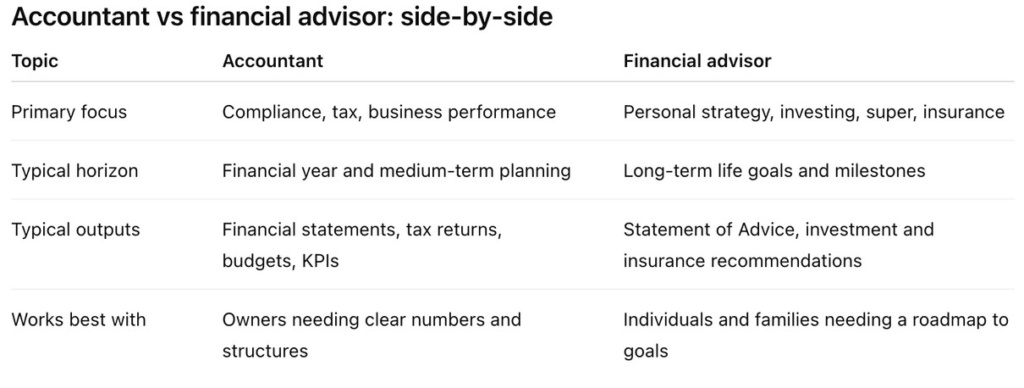
Why it matters: Accountants keep the financial engine room accurate and efficient. Financial Advisors help you choose where the ship is heading and why.
Accountant Vs Financial Advisor: Do You Need One, The Other or Both?
For many people it is rarely either-or. The strongest outcomes come when your accountant and financial advisor work together:
- Tax-aware investing: Advisors propose strategy. Accountants assess tax impacts and structure choices.
- Business and personal wealth: Accountants optimise the business. Advisors help convert profits into long-term wealth and retirement income.
- Risk and compliance: Advisors recommend cover. Accountants ensure premiums and structures are efficient for tax and cash flow.
Sometimes, the synergy of both an accountant and a financial adviser can significantly benefit your finances. Each professional brings unique expertise, ensuring comprehensive financial management.
Key collaborative benefits include:
- Holistic financial management
- Seamless strategic and compliance integration
- Enhanced financial stability and growth potential
Ultimately, leveraging their combined expertise helps ensure sustainable business growth and resilience.
When You Might Need An Accountant
An accountant is essential for most businesses, especially during periods of business expansion or restructuring. Their role ensures your financial operations align with regulatory standards and best practices.
- Starting, restructuring or selling a business
- Tax planning before 30 June and year-end compliance
- Managing payroll, GST, FBT and CGT events
- Building robust budgets, cash flow and management reports
- Navigating ATO correspondence or complex lodgements
When You Might Need A Financial Advisor
A financial advisor is helpful for long-term financial planning and strategy development. Consider hiring one when you need guidance on investment opportunities, retirement planning, or wealth management.
- Creating an investment plan and selecting diversified assets
- Consolidating super and planning contributions
- Structuring retirement income and pensions
- Setting up risk cover that suits your life stage
- Managing an inheritance or business sale proceeds
Tip: Your accountant and financial planner can and should be linked up and communicate. Ask your financial advisor to share their plan with your accountant so structures and tax outcomes line up with the strategy.
Can Accountants Give Financial Advice?
Accountants often face the question: Can accountants give financial advice? The answer is yes, but it’s nuanced.
They primarily offer advice on tax efficiency and financial reporting. This includes suggesting ways to minimise tax liability.
However, their advice is usually centred around compliance and financial accuracy. It doesn’t typically include investment strategy or wealth management.
In summary, accountants can guide you on:
- Tax planning and strategy
- Financial reporting and compliance
- Cash flow management
For broader financial planning, a financial advisor needs an Australian financial services (AFS) licence to be able to provide personal financial advice and recommendations. Both professionals can complement each other for optimal financial health.
FAQs About Accountants and Financial Advisors
Accountants focus on tax, compliance and business performance using your financial data. Financial advisors focus on long-term personal strategy, investments, superannuation and insurance.
Yes and it’s usually beneficial when your accountant and financial advisor collaborate and communicate to deliver optimum financial efficiency and outcomes.
No – accountants can give general tax-related guidance. Personal financial product and investment advice is provided by licensed financial advisers who issue a Statement of Advice.
Not usually. Only registered tax agents prepare and lodge tax returns for a fee. Your advisor and accountant should collaborate so recommendations are tax-aware.
Both professionals offer distinct benefits but, for many people, using them both usually results in better financial outcomes. When you are navigating significant changes such as business sale, retirement planning or significant investment changes, it’s always advisable to engage both an accountant and a financial advisor. The advisor sets strategy and the accountant optimises structure and tax.
Check credentials, be clear on scope and fees, and confirm how they will collaborate. Ask for an engagement letter from your accountant and a Financial Services Guide from your advisor.
How MGI South Qld Can Help
As a full service accounting firm we offer the full range of accounting services to support business owners, professionals and families across South East Queensland including tax compliance, CFO advisory, business coaching and mentoring and audit and assurance.
We also have a network of professionals including financial advisors, lawyers and bookkeepers, that we can link our clients with to ensure a ‘joined up’ financial strategy.
At MGI we help businesses and individuals across SE Qld including Brisbane, the Gold Coast and Sunshine Coast with the full range of accounting and business advisory services.
Scion Private Wealth is a Brisbane financial advisor and a trusted referral partner of MGI South Qld. They support many of our clients with retirement planning, investment management, intergenerational wealth management and integrated tax planning services.
Whatever your financial needs, contact us today so we can help you to make smart, informed financial decisions.